Posts with «technology & electronics» label

The Morning After: Sony is buying the studio behind ‘Destiny’ for $3.6 billion

It’s another big game studio deal. Sony has announced plans to acquire Bungie, the studio behind the hit sci-fi MMO shooter Destiny, in a deal worth $3.6 billion. Bungie is positioning the acquisition as the start of a new era for the company — one focused on global multimedia entertainment, not just games. One notable point: Bungie will continue to develop for multiple platforms, not just PlayStation, according to a blog post by CEO Pete Parsons. It’s another sign of the video game industry consolidating. In case you forgot, last month Microsoft announced it was buying Activision Blizzard for $69 billion.

— Mat Smith

The biggest stories you might have missed

Kia's EV6 is the new benchmark for affordable electric cars

Superior range to the ID.4 and a lower price than the Model Y.

Hyundai

The EV6 is the first Kia vehicle under the company’s new Plan S electrification strategy, leading the way for nearly a dozen new EV models by 2026. It’s not just packing a great range, a competitive price and Level 2 autonomous driving but also some augmented reality tricks. Senior Editor Andrew Tarantola takes a drive.

Continue reading.

Sony's first 2022 State of Play will be a 'Gran Turismo 7' showcase

The event streams tomorrow.

Gran Turismo 7, finally coming to the PS4 and PS5 on March 4th after significant delays, will be the focus of Sony's first State of Play in 2022. The event is set to stream at 5 PM ET this Wednesday (February 2nd) and will feature “just over 30 minutes of new [GT7] PS5 footage and gameplay details.”

Continue reading.

Grindr disappears from Apple's App Store in China

China's Personal Information Protection Law might be to blame.

Reuters

One of the biggest gay dating apps has disappeared from China’s Apple App Store. There was no immediate explanation for the departure, but it came just days after China's Cyberspace Administration launched a campaign to purge illegal online material, porn and rumors ahead of the Winter Olympics.

Grindr’s developers may have removed the app due to the potential for problems stemming from China's Personal Information Protection Law, which governs private data. It requires any cross-border data transfers to go through China's Cyberspace Administration.

Continue reading.

Meta's upgraded 3D avatars work across Facebook, Instagram and VR

Drawing all the company’s parts closer together.

Meta is rolling out updated 3D avatars to Facebook, Messenger and Instagram (via DMs and Stories). The new design lets you bring the same avatar across Meta's platforms, including VR — if you’re using a Quest 2 headset. If you want some degree of separation, you can still create different avatars for Facebook, Instagram and VR, so you can have a more realistic persona for VR meetings and a more fantastical one for your social media presence.

Continue reading.

This is why your Apple two-factor texts include strange tags

The move helps thwart phishing attacks.

If you've noticed Apple's two-factor authentication texts include much more text than you're used to, that’s on purpose. Apple has implemented a system that uses domain-bound codes for sign-ins. The extra tags, for example, "@apple.com #123456 %apple.com," are meant to improve the trustworthiness of auto-filling text codes. The technique theoretically discourages more sophisticated phishing attacks that try to intercept and redirect two-factor verification messages.
Continue reading.

Meta is winding down its low-cost WiFi program for developing countries

Meta is ending its Express Wi-Fi program designed to provide low-cost internet in developing countries through partnerships with local communities, mobile operators and businesses. Launched in 2016, it wasn't free like Meta-owned Facebook's failed Free Basics program, struck down by Indian courts for violating net neutrality. Instead, it was designed to be inexpensive, starting at around 15 cents for 100MB or $5 for 20GB. 

Facebook partnered with satellite companies, ISPs and others in places like India, South Africa and the Philippines. Retailers were able to sell hotspots at reasonable rates decided by them and the operator, rather than Facebook. Meta would benefit, of course, by gaining access to new customers it no doubt hoped would create Facebook accounts. As with Google, most of the company's recent growth has come from developing countries where people are getting online for the first time. 

Recently, The Wall Street Journal reported that glitches in Meta's free internet services were creating unwanted charges for users in countries like Pakistan. Meta was also reportedly favoring its own content on its free-data Discover service to the detriment of other sites. 

Meta said that while it's winding down Express Wi-Fi, it's focusing on other projects around internet access. "While we are concluding our work on this program to focus on developing other projects, we remain committed to working with partners across the telecom ecosystem to deliver better connectivity,” a Meta spokesperson said in a statement. It promised to work with Express Wi-Fi partners to "minimize the impact to their businesses while keeping networks running." 

PS4 and PS5 users can show Discord friends what they're playing

Starting today, PS4 and PS5 players can connect their PSN account to Discord. At the outset, that means you'll be able to display your PlayStation game activity on your Discord profile and let friends there see what you're playing — something Xbox players have been able to do since 2018. If you like, you can display your PSN ID on your Discord profile to make it easy for folks to add you as a friend there.

To get started, open the Discord app or website on PC or mobile, then go to the Connections section of the User Settings. If you can connect your PSN account, you'll see a PlayStation icon. Discord is gradually rolling out the feature to everyone, starting with folks in the US, so you might not have access right away.

These are useful features, especially with crossplay becoming more commonplace and friends playing games together on different platforms. If you're an Xbox owner, for instance, you'd be able to hop on Discord and see if your friends are playing Destiny 2 or Rainbow Six Extraction on PC or PlayStation, and hop in to play with them.

Discord

We're starting to see the results of a partnership Sony and Discord announced last May. "Our goal is to bring the Discord and PlayStation experiences closer together on console and mobile starting early next year, allowing friends, groups, and communities to hang out, have fun, and communicate more easily while playing games together," Sony Interactive Entertainment CEO Jim Ryan said at the time. SIE also made a minority investment in the messaging and voice and video chat platform.

Microsoft was previously said to be in talks to buy Discord for at least $10 billion. Other suitors were reportedly interested, though Discord remains an independent company. Still, with so many enormousgamingdeals being agreed already this year, who knows what the future holds?

In the meantime, Discord and Sony are looking at other ways to collaborate. "We’re excited to continue our partnership with PlayStation and explore how we can collectively create great shared experiences for your friends and communities," Discord wrote in a blog post.

Here's why your Apple two-factor texts include strange tags

If you've noticed that Apple's two-factor authentication texts include much more extra text than you're used to, don't fret — there's a good reason for it. As Macworldexplains, Apple has implemented a previously proposed system that uses domain-bound codes for sign-ins. The extra tags (such as "@apple.com #123456 %apple.com") are meant to improve the trustworthiness of autofilling text codes in platforms starting with iOS 14, iPadOS 14 and macOS Big Sur.

The technique theoretically discourages more sophisticated phishing attacks that try to intercept and redirect two-factor verification messages. If you're using one of those more recent operating systems, you'll only get a code autofill suggestion if the domain of the site requesting a code matches the one in the text. A phishing site can't simply prompt Apple for a code and expect an autofill prompt, then. If you don't get an autofill prompt, there's a good chance the site is bogus.

Apple quietly started delivering codes in the new format around November 2021. The concept isn't necessarily limited to Apple's ecosystem, but it has yet to be widely adopted elsewhere. Still, don't be surprised if these lengthy 2FA texts become more commonplace and potentially thwart some phishing campaigns.

The best Super Bowl TV deals we could find

Game day is right around the corner, which means it’s one of the best times of the year to upgrade your TV. Aside from the holiday shopping season, the few weeks leading up to the Super Bowl have some of the best TV deals you’ll find throughout the year. Sets from Samsung, LG, Hisense and others can be hundreds of dollars off and you can even find devices like soundbars and streamers for less, too.

Just keep in mind that often the best discounts will be on more expensive TVs. That’s great if you’re looking for a high-end or very large television for your living room, but not ideal if you’re on a strict budget. But retailers like Amazon and Best Buy still have a bunch of TVs under $500 that are worth considering if you don’t want to spend too much — and it's possible to save money on those, too.

If you’re going to upgrade this year and plan to order online, we recommend doing so soon so you can have the new tube delivered and set up before game day arrives. Here are the best Super Bowl TV deals we could find, plus a few other home entertainment sales that are worth considering.

50-inch Samsung Class 7 4K smart TV

This highly-rated 50-inch Samsung 4K TV is $80 off and down to $400. This Tizen set has a crystal display plus support for HDR, Motion Rate 120 and Game Enhancer.

Buy 50-inch Samsung Class 7 4K TV at Best Buy - $400

55-inch Hisense U7G Quantum Dot 4K smart TV

Hisense's 55-inch Quantum Dot 4K TV is 30 percent off and down to just under $600. It packs a lot of value into a relatively affordable TV — the set supports a 120Hz native refresh rate, Dolby Vision and Atmos, 1,000 nits of peak brightness and Game Mode Pro, the latter of which makes use of HDMI 2.1, low latency mode, variable refresh rates and more.

Buy 55-inch Hisense Quantum Dot 4K TV at Amazon - $600

55-inch Samsung QN90A Neo 4K smart TV

Samsung's 2021 55-inch Neo QLED smart TV is $300 off and down to $1,300. It uses Quantum Mini LED technology to improve details in both dark and bright scenes, and it supports things like 4K AI upscaling, Quantum HDR, 120Hz refresh rates, FreeSync Premium Pro and more.

Buy 55-inch Samsung QN90A 4K TV at Amazon - $1,300Buy 55-inch Samsung QN90A 4K TV at Best Buy - $1,300

65-inch Samsung The Frame 4K smart TV

Samsung

Samsung's 65-inch Frame set is down to a record low fo $1,500, which is $500 off its normal price. In addition to 4K support and Quantum Dot technology, the Frame TVs have Art Mode, which lets you show pieces of art on the screen when you're not using it.

Buy 65-inch Samsung Frame 4K TV at Amazon - $1,500Buy 65-inch Samsung Frame 4K TV at Best Buy - $1,500

65-inch LG C1 OLED 4K smart TV

LG's 65-inch C1 OLED set is on sale for $1,800, or $300 off its normal price. In addition to excellent contrast, intense colors and webOS 6.0, it supports HDMI 2.1, NVIDIA G-Sync and FreeSync Premium for a better gaming experience along with Google Assistant and Amazon Alexa voice commands.

Buy 65-inch LG C1 OLED TV at Amazon - $1,800Buy 65-inch LG C1 OLED TV at Best Buy - $1,800

75-inch Hisense E9DG Dual-Cell 4K smart TV

This 75-inch Hisense set is down to $2,000, or $1,000 off its normal price. It uses a luminance control panel behind the 4K screen to manage color more accurately, plus it has high contrast and up to 1,000 nits of peak brightness. The set also supports HDR, Dolby Vision, 120Hz refresh rates, low latency mode, VRR and more.

Buy 75-inch Hisense E9DG 4K TV at Amazon - $2,000Buy 75-inch Hisense E9DG 4K TV at Best Buy - $2,000

77-inch Sony Bravia XR A80J OLED 4K smart TV

This large Sony OLED smart TV has been discounted by $600, bringing it down to $2,900. It uses Sony's Cognitive Processor XR for strong performance and Acoustic Surface Audio+ for immersive sound, plus it supports 4K AI upscaling, XR Motion Clarity, HDMI 2.1 and more.

Buy 77-inch Sony XR A80J OLED TV at Amazon - $2,900Buy 77-inch Sony XR A80J OLED TV at Best Buy - $2,900

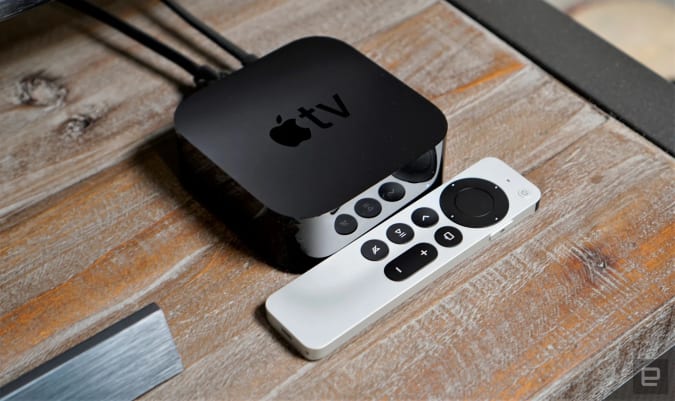
Apple TV 4K

The latest Apple TV 4K is on sale for $160, or $20 off its normal price. While the 2021 version isn't drastically different from the previous model, its new Siri remote is a big selling point. We gave it a score of 90 for its speedy performance, HomeKit integration and the easy of use that comes with the improved Siri remote.

Buy 2021 Apple TV 4K at Amazon - $160

Roku Streambar Pro

Roku

The Streambar Pro is $30 off and down to an all-time low of $150. It has all of the features that the standard Streambar does along with four 2.5-inch full range drivers, private listening and a lost remote finder in the Roku mobile app.

Buy Streambar Pro at Amazon - $150

Fire TV Stick 4K

Amazon

Amazon's Fire TV Stick 4K has been discounted to $30, which is 40 percent off its normal price. This gives you 4K streaming with Dolby Vision in an ultra-compact package, and the stick also supports Dolby Atmos audio and Alexa voice commands.

Buy Fire TV Stick 4K at Amazon - $30

Fire TV Cube

Nicole Lee / Engadget

The Fire TV Cube is down to $85, or only $10 more than its record-low price. Despite being a few years old, it's still a strong set-top box and the most powerful in Amazon's lineup. It supports 4K HDR streaming, Dolby Vision and Atmos, HDR10+ and Alexa controls for both your TV and compatible smart home gadgets.

Buy Fire TV Cube at Amazon - $85

Optoma CinemaX P2

Steve Dent / Engadget

Optoma's CinemaX P2 projector is $800 off, bringing it down to $2,499. This earned a spot in our best projectors guide thanks to its 3,000 lumen brightness, improved color accuracy and 80 percent DCI-P3 coverage.

Buy CinemaX P2 at Amazon - $2,499

Follow @EngadgetDeals on Twitter for the latest tech deals and buying advice.

Dating app Grindr disappears from Apple's App Store in China

Grindr is still facing trouble in China. Bloombergreports the gay dating app has disappeared from Apple's App Store in the country, with researchers at Qimai estimating the software was removed on January 27th. There was no immediate explanation for the departure, but it came just days after China's Cyberspace Administration launched a campaign to purge illegal online material, porn and rumors ahead of the Winter Olympics.

We've asked Apple and Grindr for comment. The app's departure came after weeks of glitches with Grindr's service, such as problems adding likes or sending messages.

Homosexuality is not a crime in China. Nonetheless, the country has occasionally censored gay and other LGBT content. Bloombergnotes the National Radio and Television Administration has recently used homophobic terms to blast androgynous-looking men, and has called for boycotts of gay male love stories. If regulators ordered Grindr's removal, it may have been part of this larger campaign to impose social conformity.

With that said, Grindr already had a fraught relationship with the Chinese government. The company was Chinese-owned before it was forced to sell due to US sanctions, and China-based rivals like Blued remain on the App Store despite Grindr's disappearance. If those apps persist, their presence would suggest China singled out Grindr instead of targeting all gay dating apps.

Whatever the reasons, the removal highlights a constant problem for Apple and other foreign app store owners who want to operate in China. While they may tout the importances of freedom and privacy in their home countries, China's rules frequently force them to pull apps or exclude features if they want to continue participating in one of the world's largest mobile device markets. Simply put, companies like Apple have to accept compromises if they want to retain a significant Chinese presence.

Joby gets serious about audio with new mics for podcasters and streamers

Joby is still better-known for its GorillaPods than any of its audio gear, but it's aiming to change that with a significantly expanded lineup. The company has introduced several microphones built for creatives like podcasters and streamers, and it's clearly chasing after incumbents like Blue and Rode. The Wavo Pod (pictured above), for instance, is a USB condenser microphone aimed at would-be Blue Yeti buyers. The simple upright design and boom support will seem familiar, but Joby is counting on the 24-bit/48KHz sampling (versus the Yeti's 16-bit/48KHz), an included pop filter and a lower $100 price to sway customers. It's available today.

Joby

The Wavo Pro (middle) and Wavo Pro DS, meanwhile, are shotgun mics (similar to Rode's) built to pair with mirrorless cameras used by vloggers and some streamers. The $300 Pro touts active noise reduction through a hybrid analog/digital system, a secondary 3.5mm mic input and visual monitoring through Bluetooth-connected apps for Android and iOS. It's available now, but you can wait until March 4th for the $250 Pro DS with a slightly "streamlined" (read: cut-down in unspecified ways) experience.

Other models are more specialized. The $250 Wavo Air (below) is an instant-pair 2.4GHz wireless microphone kit that packs two transmitters, two lavalier mics and adapters to plug into cameras and phones. The $80 Wavo Lav Pro is billed as Joby's first "pro-grade" lavalier mic with a higher-end capsule and foam windscreen, an 8.2ft cable to reduce vibrations and a 3.5mm TRS connector. Both the Air and Lav Pro are available now.

Joby

These introductions won't necessarily sway you if you're already leaning towards more established options. With that said, the pricing and features seem compelling in some cases, particularly for the Pod, Pro and Air. It's just a question of whether they fare well in real-world conditions, and whether Joby's ecosystem (including GorillaPods) might influence your choice.

Roku's Streambar Pro drops to a record low of $150

If you're looking for a way to upgrade your TV setup before the big game without dropping too much money, one of Roku's soundbars could do the trick. Both the Streambar and the Streambar Pro are already competitively priced compared to other soundbars, but now you can get the Streambar Pro at its lowest price yet — only $150. The smaller Streambar has also been discounted to $100, but it's hovered at that sale price for a few months now.

Buy Streambar Pro at Amazon - $150Buy Streambar at Amazon - $100

The Streambar Pro is the larger cousin of the standard Streambar, and it adds a few extra features into the mix. First and foremost, it's larger and houses four 2.5-inch full range drivers and supports virtual surround sound. We were impressed by the Streambar's audio capabilities, particularly when watching action movies and content that has a lot of sound effects, so you'll likely get even better sound out of the Streambar Pro. The larger soundbar also supports private listening with included headphones, personal shortcut buttons on its remote and a lost remote finder using the Roku mobile app.

On top of that, the Streambar Pro has all of the features that the smaller soundbar does, including built-in 4K HDR streaming technology, Dolby Audio support and Bluetooth speaker capabilities. You're essentially getting a 3-in-1 device here — a soundbar, a Bluetooth speaker and a set-top box all in one. You also have your choice of voice assistant to use with the Streambar Pro as it supports commends with Siri, Alexa and the Google Assistant. If you don't want to drops hundreds on a new TV this year before the big game, updating your sound system while you can get the Streambar Pro for less is a good alternative.

Follow @EngadgetDeals on Twitter for the latest tech deals and buying advice.

Apple's 2021 cellular iPad Mini falls to a new all-time low at Amazon

The cellular iPad Mini is a top choice for road warriors, offering 5G capability along with WiFi 6 so you can stay connected wherever you are. Given the desirability of that feature, however, it's rather expensive at $649 and we've rarely seen it go on sale. Luckily, if you've been eyeing one, it's now available at Amazon for $600, or $49 off the regular price — the steepest discount we've seen so far. 

Buy 2021 cellular iPad Mini at Amazon - $600

The 2021 model has similar specs to the iPhone 13, with the same speedy A15 Bionic chip that delivers a big jump in performance over the fifth-gen model. It comes with a larger 8.3-inch display with higher 2,266 x 1,488 resolution and eliminates the physical home button, moving the Touch ID sensor to the power button. The volume buttons, meanwhile, are at the top to make room for Apple Pencil 2 that can be attached to the side magnetically.

Other features include USB-C charging and upgraded cameras with support from Apple's Center Stage feature, keeping you in the center of the frame during video calls. The main downsides are the lack of a headphone jack, limited 64GB of storage on the base model, and a higher price, particularly with the cellular model. Also keep in mind that the 5G doesn't support mmWave, so don't expect a big jump in wireless speeds compared to LTE. 

If you're fine with the 5G limitations and 64GB storage, Amazon has at least taken the edge off the price. The $600 price for the 64GB cellular model is available on all four listed colors, but it's best to act soon before the sale ends.

Follow @EngadgetDeals on Twitter for the latest tech deals and buying advice.

At-home COVID-19 tests could be more affordable thanks to your smartphone

Ever since the omicron variant arrived in the US, there’s been a testing shortage in the country. Stuck between long lines at dedicated clinics and overly expensive at-home tests, many Americans have understandably given up the idea of getting tested to ensure they’re not sick with COVID-19. However, a solution to some of those problems could be on the way.

University of California, Santa Barbara

In a newly published paper spotted by Gizmodo, researchers from the University of California, Santa Barbara, detailed a system you can start using for about $100 should you already have access to a relatively modern phone. What’s more, they say early results show their process is nearly as accurate as a PCR test (and thankfully doesn’t involve tickling your brain).

In its current iteration, the system involves downloading the team’s Bacticount app to your phone, as well as making use of a hot plate and a cardboard box with a LED light. When you need to test yourself, you place a saliva sample onto a testing kit that costs about $7. You then drop a reactive solution that makes it easier for your phone’s rear camera to detect any viral RNA in the sample. The solution turns a bright red as it bonds with the viral material in your saliva. The Bacticount app then conducts a real-time analysis based on how quickly the solution turns red.

As you might imagine, there’s still plenty of work to be done before you can start using the SmaRT-LAMP test at home. The initial study is based on a small sample size involving 50 symptomatic and asymptomatic individuals. Moreover, the Bacticount app is so far only optimized to work with the Samsung Galaxy S9. Still, the system shows promise. While it was developed primarily to aid with testing in places that don’t have access to adequate resources, Dr. Michael Mann, the lead researcher on the project, told Gizmodo that it could be adapted for at-home use. He also said it could be modified to detect new COVID-19 variants and other pathogens like the flu.