Apple will host its next hardware event sometime on or around March 8th, according to Bloomberg. At the event, the company will reportedly announce the third-generation iPhone SE, a refresh of the 2020 iPad Air and a new Mac computer that will feature an Apple Silicon chip. The date aligns with the March to April timeframe Bloomberg’s Mark Gurman previously said Apple had set for the SE’s debut but warned potential production delays could force the company to change its plans.
As before, the new phone will reportedly feature a 5G modem, a first for the SE line. It’s also expected to include a faster processor and a better camera. However, it will retain the iPhone 8-era design of the current model. As for the new iPad Air, it too will get a processor refresh and the addition of 5G connectivity. Bloomberg didn’t say much about the new Mac that Apple may announce at the same event, but most recent reports point to the company unveiling a new 27-inch iMac Pro model.
If the idea of a new iPhone SE isn’t too exciting for you, the good news is Bloomberg reports Apple also plans to release iOS 15.4 sometime in the first half of March. Among other enhancements, the update is expected to add a feature that will allow you to unlock your iPhone with Face ID even while wearing a mask.
The Magic Eraser feature on Pixel 6 and Pixel 6 Pro is a handy tool that does a solid job of removing unwanted objects or people from photos. However, users are experiencing a bug that crashes the Google Photos app when they use it.
Folks have flagged the issue on Reddit and Twitter. As Android Police notes, some have tried clearing the Google Photos cache and restarting their handset, but that doesn't seem to resolve things.
Users have experienced other issues with Magic Eraser and Google Photos. An app update in November accidentally removed the feature, but Google swiftly remedied that. Engadget has asked Google when users can expect a fix for the latest problem.
Magic Eraser was touted as one of the most compelling new features in the Pixel 6 lineup and it certainly didn't hurt device sales. Google parent Alphabet said in its earnings report this week that it set an all-time quarterly sales record for Pixel in the last three months of 2021 even in the face of ongoing supply chain issues.
In a few short days, Samsung will host its first Unpacked of 2022. While the company is sure to stage many more events throughout the year (too many, if you ask us), the first one is always the most exciting. That’s because it’s usually where Samsung has announced the next iteration of its flagship Galaxy S line, and Wednesday’s Unpacked promises to be no different. On February 9th, the company is expected to unveil the Galaxy S22. No surprise there, but there could be more to that announcement than you might anticipate. Let’s break down everything we expect to see from the company later this week.
Galaxy S22 and Galaxy S22+
Evan Blass
Much like it did in 2021, Samsung is expected to launch a trio of new Galaxy S phones. As you’ll see in a few moments, the S22 Ultra is likely to be a significant departure from its predecessor. But as for the S22 and S22+, the expectation is that they’ll be more iterative updates.
Prerelease reports suggest they’ll feature a similar design with the same “Contour Cut” rear camera housing that you’ll find on the Galaxy S21 and its Fan Edition offshoot. As far as upgrades go, most leaks point to the Galaxy S22 featuring a new glass back and both phones coming with 50-megapixel main cameras. More interesting is what could be inside the phones.
Evan Blass
As it’s done in years past, Samsung is expected to source two different chipsets for the Galaxy S line in 2022. In North America, the phone will likely feature the Snapdragon 8 Gen 1. That would make it one of the first phones to bring Qualcomm’s latest flagship SoC to the US and Canada. Meanwhile, in Europe and other parts of the world, the S22 will almost certainly come with Samsung’s own Exynos 2200.
Announced in January, the 4nm chip features an “Xclipse” GPU powered by AMD’s RDNA 2 architecture. In practice, what makes the Exynos 2200 noteworthy is that Samsung claims it’s capable of ray tracing. Early benchmarks suggest the Exynos 2200 could also be faster than its Qualcomm counterpart. All of that would make the potential differences between the North American and European versions of the Galaxy S22 more notable than in years past.
Whoever said S22 series was to be cheaper, didn't think of Covid, parts shortages and inflation.
What we’re less clear on is how Samsung plans to price the Galaxy S22. In a recent tweet, WinFuture’s Roland Quandt said the base model S22 and S22+, both with 8GB of RAM and 128GB of internal storage, would start at €849 and €1049, respectively. Those prices suggest the company won’t charge more for the S22 and S22+ than it did for the S21 and S21+. However, a separate leak from earlier in the month suggested every model in the S22 line could cost $100 more than its S21 counterpart. We’ll have until the 9th to get a better sense of those details.
Galaxy S22 Ultra
Evan Blass
Shortly before Samsung announced it was hosting an Unpacked on February 9th, company president TM Roh teased the event would feature “the most noteworthy S series device we’ve ever created.”
After component shortages and a pandemic-fueled decline in demand for high-end phones led Samsung to skip the Note line in 2021, the fan-favorite phone is coming back this year. In all but name, we expect the Galaxy S22 Ultra will be the Note 20 successor Samsung fans have been waiting to see for nearly two years. But don’t TM Roh’s or our word for it. In the weeks leading up to Wednesday’s Unpacked, images of the S22 Ultra leaked multiple times.
Here's that 45W PD Charger for your new S22 Ultra (EP-T4510)
Renders shared by Evan Blass of Evleaks fame suggest the S22 Ultra will feature a dramatically different design from the rest of the S22 lineup. Not only will the phone seemingly come with an S-Pen stylus in the box, but it will also feature a curved display and flat backplate. What’s more, judging from photos shared by Front Page Tech, the S22 Ultra will include a slot for storing an S-Pen inside of the phone.
A set of alleged prerelease marketing images shared by Blass suggest the S22 Ultra will feature a quad-camera array with a 108-megapixel main camera, 12-megapixel ultrawide and two 10-megapixel telephoto cameras with Samsung’s 100x Space Zoom feature built-in. The leaked marketing material also suggests the phone will feature a 6.8-inch AMOLED display with 120Hz refresh rate and QHD+ resolution.
S22 Ultra camera 108MP+12MP+12MP+12MP, wrong 108MP+10MP+10MP+12MP, correct 108mp Improved version of HM3 main 1 / 1.33 "0.8 um F1.8 FOV 85 12MP 0.6X sony 1/2.55" 1.4um F2.2 FOV 120 10MP 10X new sony 1/3.52" 1.12um F4.9 FOV 11 10MP 3X new sony 1/3.52" 1.12um F2.4 FOV 36 pic.twitter.com/RsS9fPK0hC
Internally, the S22 Ultra is expected to include many of the same components found in the S22 and S22+. However, one potential source of drama related to the S22 Ultra may come down to how much RAM you’ll find in the base model. According to Roland Quandt, the most affordable S22 Ultra variant will ship with 8GB of memory. At the same time, it will cost as much as the entry-level Galaxy S21 Ultra, which came with 12GB of RAM. Per Quandt, European consumers will need to pay a €100 premium to get the model with 12GB of RAM and 256GB of internal storage. It’s unclear if Samsung will implement the same pricing strategy in the US.
Galaxy Tab S8 and Tab S8 Ultra
Evan Blass
Samsung has been making Android tablets long enough for Google to first abandon the form factor and then more recently declare that it’s the “future of computing.” So it should come as no surprise reports suggest the company will update its Tab line at Unpacked. According to a separate leak from Quandt, we can expect the company to equip the 11-inch Tab S8 with a Snapdragon 8 Gen 1, 8GB of RAM, up to 256GB of internal storage, an 8,000mAh battery and a 120Hz LCD display.
As for the larger Tab S8+, Quandt suggests it will feature a 12.7-inch OLED display and a bigger 10,090mAh battery while being slightly thinner than its smaller sibling. We’ll note here some reports had said the Tab S8+ could feature a 12.4-inch display. Either way, both models are expected to come with a bundled S-Pen stylus.
Samsung Galaxy Tab S8 series official EURO prices:
But that’s not all, we also expect Samsung to add a new model to the Tab line. Per Quandt, the company will announce the Tab S8 Ultra on February 9th. It will reportedly feature a monstrous 14.6-inch AMOLED screen, up to 16GB of RAM and dual-front facing cameras housed in an unsightly display cutout. It could also come with a feature that would allow you to use the Galaxy S22 Ultra as a separate color palette when drawing with the S-Pen, which is exactly the sort of parlor trick only Samsung would think of to sell you on its most expensive devices.
Everything else
By all accounts, the first Unpacked of 2022 will see Samsung focus on the Galaxy S22 and Tab S8. The company could surprise us with updates to its foldable and watch lineups, but so far there haven’t been any leaks and reports to suggest that will happen. Either way, you’ll want to visit Engadget on February 9th. We’ll have comprehensive coverage of all the company’s biggest news.
Catch up on all of the news from Samsung’s February Unpacked event right here!
In addition to a bunch of great deals on TVs ahead of the big game, a handful of new tech deals cropped up on the web this week. Roku's Streambar Pro is $30 off and down to $150 right now (and the smaller Streambar has also been discounted) while the latest Apple TV 4K remains on sale for $160. Fitbit's Charge 5 fitness tracker is 34 percent off and down to an all-time low, plus you can still save on a bunch of Eero 6 WiFi systems. Here are the best deals from this week that you can still get today.
2021 Apple TV 4K
Devindra Hardawar/Engadget
The latest Apple TV 4K is on sale for $160, or $20 off its normal price. While the 2021 version isn't drastically different from the previous model, its new Siri remote is a big selling point. We gave it a score of 90 for its speedy performance, HomeKit integration and the easy of use that comes with the improved Siri remote.
A bunch of Apple Watch Series 7 models are on sale at Amazon right now. The 45mm GPS Series 7 in midnight is down to a record low of $370, or $60 off, while a few colors of the 41mm GPS Series 7 are down to $350, which is only $10 more than the all-time-low price. Finally, the 41mm GPS + Cellular Watch is $50 off and down to $449.
A few colors of the high-end AirPods Max are $100 less than usual, bringing them down to $449. These cans earned a score of 84 for their excellent, balanced sound, strong ANC and good battery life.
Roku's Streambar Pro is on sale for $150, or $30 off its normal price. The regular Streambar is also on sale for $99. The Pro model includes all of the features that the standard soundbar does, plus four 2.5-inch full range drivers, support for private listening and a lost remote finder in the companion mobile app.
Hisense's 55-inch Quantum Dot 4K TV is 30 percent off and down to just under $600. It packs a lot of value into a relatively affordable TV — the set supports a 120Hz native refresh rate, Dolby Vision and Atmos, 1,000 nits of peak brightness and Game Mode Pro, the latter of which makes use of HDMI 2.1, low latency mode, variable refresh rates and more.
Samsung's 65-inch Frame set is down to a record low fo $1,500, which is $500 off its normal price. In addition to 4K support and Quantum Dot technology, the Frame TVs have Art Mode, which lets you show pieces of art on the screen when you're not using it. The 55-inch model is also back on sale for an all-time low of $1,000.
The Samsung T7 Touch SSD in 1TB is down to a record low of $140 right now. That's even better than the price it was during the holiday shopping season last year. We like the drive's compact design, fast speeds and built-in fingerprint reader for extra security.
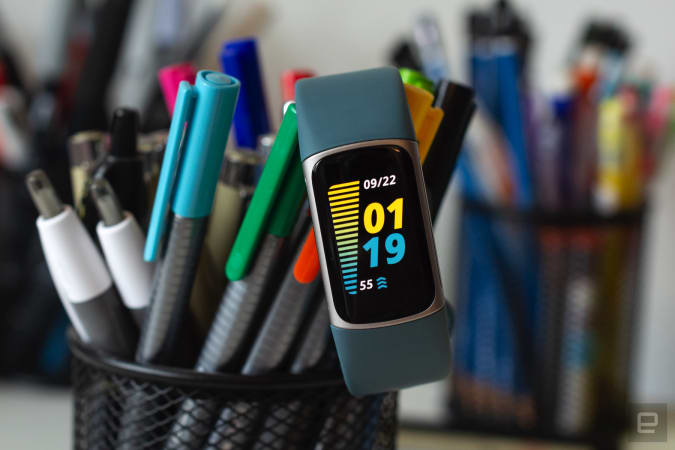
Fitbit's Charge 5 is on sale for a record low of $120 right now. We gave the fitness tracker a score of 82 for its large, full-color display, built-in GPS, standard Fitbit Pay and long battery life. The Fitbit Sense smartwatch is also on sale for $100 less than usual, bringing the price down to $200.
Microsoft's Elite Wireless Series 2 controller for Xbox remains on sale for $140, or $40 less than usual. If you want to treat yourself (or someone else) to a fancy gaming accessory, this is a good option. It comes with six thumbsticks, four paddles, two D-pads, a charging dock, a carrying case and a USB-C cable, and its battery can last up to 40 hours on a single charge.
Samsung's latest smartphone, the Galaxy S21 FE, is officially available and starting to ship and Amazon throws in a $100 gift card if you order the handset through the online retailer. We gave the phone a score of 77 for its bright 120Hz display, hi-res selfie cam and long battery life.
All Eero 6 WiFi packs are on sale right now, so you can one for as low as $90. The three-pack of routers is down to $244 while the three-pack with one router and two extenders has been discounted to $195. This system supports WiFi 6, up to 5,000 square feet of coverage and it has a built-in Zigbee smart home hub.
Arturia has discounted a number of its software instruments and effects through February 17. Arguably the highlight of the sale is Pigments, which is 50 percent off and down to $99.
Crucial's MX500 internal SSD in 1TB is on sale for $90 — not the lowest price ever, but close to it. We like this drive for its decent read and write speeds, AES 256-bit hardware-based encryption and integrated power loss immunity.
This Logitech webcam is down to $80, which is 20 percent off its normal price. Its 1080p/30fps recording quality will be great for both Zoom meetings and game streams, plus it has built-in autofocus and two mics to capture your voice in stereo audio.
Garmin's Forerunner 45s running watch is 30 percent off right now and down to $140. The "s" means the case is on the smaller side, making it better for people who don't want a chunky smartwatch. It has a built-in GPS to track and map outdoor runs and it monitors pace, distance, intervals and more.
A bill targeting Apple and Google's app store restrictions has taken a step forward. The Senate Judiciary Committee voted 20-2 to advance the Open App Markets Act, with only Sens. John Cornyn and Thom Tillis opposing. The vote showed once again that there's bipartisan support for the bill.
Should the legislation become law as it stands, it would prevent app marketplace owners with more than 50 million users in the US from locking third-party developers into their payment systems. The App Store and Google Play Store, which require third-party apps to use their respective payment systems, pass that threshold.
They wouldn't be able to block or punish developers from offering apps at other prices on different platforms, and they'd have to let developers contact their users with "legitimate business offers, such as pricing terms and product or service offerings." Another provision would force Apple and Google to let users install third-party app stores or sideload apps. This would have a bigger impact on Apple, since Android already allows sideloading.
Apple and Google have opposed the bill, claiming that it would put user security and privacy at risk. They said the same things about the American Innovation and Choice Online Act, a more sweeping tech reform bill that the committee passed last month. Both bills will go to the Senate floor for debate and a vote.
The stakes are high for both companies. The App Store and Google Play Store each take a 15 percent cut of in-app purchases up to the first $1 million developers make in annual revenue. After that, the fees rise to 30 percent.
Google parent company Alphabet reports Play Store revenue under "Google other revenues," which also includes hardware and non-ad income from YouTube. That business segment brought in $8.2 billion last quarter, a year-over-year increase of 22 percent. App Store revenue falls under the Apple's services segment, which raked in $19.5 billion in Q4.
Apple was last year ordered to allow developers to direct users to other payment methods as a result of its legal battle with Epic Games. An appeals court judge granted a last-minute delay before the change was supposed to take effect.
After Sony released the A7 III way back in 2018, I wondered if Canon and Nikon could ever catch up to its autofocus and other technology. With the launch of the 24-megapixel EOS R3, however, it’s Canon that’s on the cutting edge with its “eye control” AF that lets you focus on a subject just by looking at it.
The R3 is also Canon’s first camera with a backside illuminated, stacked sensor. That gives it burst shooting speeds in silent mode of up to 30 fps with autofocus and auto-exposure enabled. Plus, it has top flight video specs with RAW capture at 6K up to 60 fps.
Here’s the rub, though: For $6,000 it has relatively low resolution, while Canon’s own 45-megapixel EOS R5 costs more than $2,000 less. So, who is this camera good for exactly? And is the eye control AF a useful feature, or just a toy? With some help from my pro photographer friends, I spent some time with a final production model to find out.
Body and handling
The first thing you’ll notice on the R3 is the big camera grip body that makes it look like a DSLR and mirrorless camera mashup. Much like the 1DX Mark III that inspired it, it has dual controls for both landscape and portrait shooting modes, including a matching shutter button, dials and joystick.
Despite the big body, the EOS R3 is relatively light at 2.3 pounds including a battery and memory card. The 1DX Mark III, by contrast, tips the scales at 3.17 pounds, while the EOS R5 is 1.6 pounds.
As you’d hope for a big camera, it has a big grip. That gives a feeling of security when you’re holding it, and it handles great even with big telephoto lenses like Canon’s RF 70-200mm f/2.8.
The R3 also packs plenty of dials and buttons so that you can operate the camera without diving into the menus, for the most part. The control layout is similar to the 1DX Mark III and uses the same infrared control button. That lets you set the focus point just by sliding your thumb over it – faster than a joystick, but easier to activate inadvertently until you get used to it.
Steve Dent/Engadget
A dedicated button lets you switch easily between photo and video modes, while giving you separate settings and menus for each mode. However, it uses the same old Canon menus, which aren’t quite as intuitive as on the latest models from Sony, Nikon and Panasonic. You can control it in a variety of ways, though, using the dials, joystick or touchscreen. That makes it quick to get to a setting, once you figure out where it is.
The big 3.2-inch touch display has a crisp 4.15-million dot resolution, nearly double that of the R5. For scrolling through menus, browsing photos and more, it’s extremely responsive – much more so than Sony’s A1 or any other camera I’ve tried for that matter. The display also flips out for low-angle shooting or vlogging, though the R3 is a bit heavy for the latter.
The 5.76-million dot OLED EVF is similarly sharp and offers a smooth 120 Hz refresh rate. It doesn’t stack up on paper to the 9.4-million dot, 240Hz EVF found on the A1, but I couldn’t see much difference between them, to be honest.
It uses the same huge LP-E19 battery from the 1DX Mark III that delivers up to 620 shots on a charge or about two and a quarter hours of 4K 30p video shooting. Depending on how you shoot, you may easily be able to exceed those figures, however.
For storage, you get one fast CFexpress type B and one SD UHS II slot. It’s nice to have the SD option if you prefer to shoot with those cards. However, if you want to back up the CFexpress card with SD, it’s going to slow performance. Since this is mostly a pro camera, Canon should have offered dual slots for both like Sony does, or perhaps two CFexpress slots.
Steve Dent/Engadget
It has a new hotshoe interface that supports Speedlite and other flashes along with accessories like Tascam’s new XLR 4-channel microphone interface. That finally matches what Sony and Panasonic have offered for years now.
The fiddly micro-HDMI port is not ideal for video shooters, and it’s an odd decision considering Canon had space with the R3’s big body. It also comes with USB-C for data transfers and in-camera charging, though you’ll need another optional accessory if you want to power the camera externally while you shoot.
Now, let’s talk about Canon’s new eye control feature. It’s only really useful if you calibrate it, but luckily that’s easy to do – you just stare at five dots. You might need to calibrate it multiple times depending on whether you’re wearing glasses and contacts, or even for different environments. Luckily, you can save up to six different settings.
Once it was calibrated, I could select an object to focus on just by looking at it. Even if the eye control circle wasn’t quite on a subject, the autofocus would usually select it if it was close. From there, the face, eye or subject tracking would kick in as needed to track the subject.
It worked even in tricky environments with lots of subjects or movement, though it turns off once you hit the focus button and start shooting. It worked fine for me, but didn’t function at all for my photographer friend with light blue eyes and an astigmatism. So if you’re interested in the feature, you may want to test it out before making a purchase, as the functionality seems to depend on your eye color and other factors.
Performance
Steve Dent/Engadget
First and foremost, the EOS R3 is a speed demon. That starts with the shutter, which goes all the way up to 1/64,000th of a second in electronic mode, faster than any other consumer camera. It also supports some of the fastest bursts we’ve seen, up to 30 fps in silent mode or 12 fps with the mechanical shutter. Unlike some recent Sony models, you get those full speeds with uncompressed and not just lossy RAW files.
You can take a lot of shots in those modes, too. At 30 fps with the electronic shutter, you can shoot 150 shots to an SD UHS II or CFexpress card before the buffer fills, according to Canon. However, I was able to shoot many more than that with a fast CFexpress card, with just a slight reduction in shooting speeds after the 150 frame mark. It’ll handle 1,000 RAW uncompressed photos or more with the mechanical shutter before stopping.
The Dual Pixel autofocus can keep up with those speeds too, so I had very few photos that weren’t sharp. Face and eye detection is fast and fluid for people, though a bit less reliable for animals or birds. The EOS R has a car tracking feature that’s mainly designed for race cars, and unfortunately I didn’t have access to a Bugatti Chiron during testing.
Shooting sports is this camera’s forte, and at an indoor soccer game with decent lighting, Samuel, the pro photographer I was working with, had only a few out-of-focus shots. It didn’t perform quite as well as the A1 did for birds, but it was still better than most cameras I’ve tried. Overall, the EOS R3 has a very powerful AF system that puts Canon right up there with Sony.
The IBIS system can deliver 8 stops of shake reduction with supported lenses, more than any rival camera. That allowed me to get sharp shots handheld at low shutter speeds when shooting in low light. And thanks to the sensor’s fast readout speeds, rolling shutter is well controlled and only noticeable on fast-moving subjects or quick pans.
Image Quality
The EOS R3 may be Canon’s best mirrorless camera yet for image quality, particularly when it comes to dynamic range. The new 24-megapixel sensor offers at least a stop more dynamic range than the EOS R5, giving you more room for adjustment with RAW images. JPEGs also look great straight out of the camera, with sharpness and noise reduction well balanced.
Canon’s color science is still the best out there, delivering stellar color accuracy and natural skin tones. As usual with Canon, it has a slight bias toward warm tones.
The R3 really shines in low light, too. Noise is nearly non-existent up to ISO 3200, with hardly any noticeable drop in dynamic range. It remains well controlled up to ISO 12,800, and images are usable at ISO 25,600 and even higher if you expose them perfectly.
The biggest downside is the lowish 24-megapixel resolution. With the 45-megapixel EOS R5 or 50-megapixel Sony A1, you can shoot birds or wildlife at a longer distance and still have room to crop in. The R3 is far more limited if you want to retain detail.
Along with my own testing, I loaned the EOS R3 to professional photographer Samuel Dejours from Studio NathSam in Gien France, to get his opinion. "The EOS R3 really handles great, though it's quite heavy. The Sony A1 is our usual camera and it's much lighter," he told me. "However, it does feel better balanced when you use a large telephoto lens. I really liked the infrared autofocus control button; I found it to be much quicker than using the joystick."
"I was excited to try the eye autofocus. However, despite all attempts of calibration, etc., it simply didn't work for me. Perhaps with my light-colored eyes, it didn't work. Hopefully that's something they can fix with a firmware update."
"It was nearly at the same level of the A1 for autofocus, though the A1 was perhaps more rapid for certain types of shooting. It was great for sports, with pretty astonishing speed and AF that almost always nailed focus. In terms of image quality, I'm not sure I'd be able to tell the A1 and EOS R3 apart if I didn't know which was which. That makes other things become more important, like the resolution, speed, etc. Overall, it was an excellent experience, and it shows that Canon is really close to Sony for speed, autofocus, video and image quality."
Video
For a sports camera, the R3 is a surprisingly strong for video. You can shoot DCI 6K RAW at up to 60 fps using the full width of the sensor. It also supports full-frame 4K shooting at up to 120 fps using All-I capture, albeit with subsampling that can reduce detail. Both of these modes also require a CFexpress card as SD-UHS II is too slow.
All other 4K modes at 60p, 30p or under support full sensor oversampling, allowing for extremely sharp video with fine detail. You can also use an APS-C crop for natively sampled (pixel-for-pixel) 4K footage that’s just a touch less sharp, if you need to zoom in slightly for example.
What about overheating? Luckily, the EOS R3 has far fewer restrictions in that regard than the R5 or R6. Regular, oversampled 4K is not temperature limited, and 6K RAW or 4K 60p is good for at least an hour. 4K at 120 fps does have a 12-minute limit, but that’s an exotic use case that would affect very few users. While using the camera, albeit in coldish weather, I received no temperature warnings – even during long takes.
Steve Dent/Engadget
The camera’s excellent high ISO performance is handy for video, allowing more flexibility for indoor shooting. Skin tones are natural and colors accurate, even in relatively low light. The R3 also supports Canon Log 3 or PQ, along with RAW or RAW light, letting you max out the dynamic range. That in turn gives you options to create HDR videos or adjust images in post.
Complimenting all that is the Dual Pixel, AI-powered AF. As we’ve seen before with Canon’s system, it reliably nails focus without any hunting or other annoying issues. Eye tracking is generally fluid and reliable as well.
It’s not quite as sticky as the AF on Sony’s A1, however. It occasionally focused on the background rather than foreground subjects or missed focus altogether. This might be fixable in a future update, though. Keep in mind that the eye control AF function only works with photos and not video.
As for the in-body stabilization with video, it’s only really good for stable handheld shooting and you’ll need a gimbal for anything else. If you try any sudden moves, the system has a tendency to jolt the image, potentially ruining shots. The electronic IBIS mode helps, but it’s not quite as smooth as I’ve seen on cameras like the A1. Meanwhile, rolling shutter is present, but it’s better controlled than on the R5.
Wrap-up
Steve Dent/Engadget
The EOS R3 is a speed demon with lowish resolution, solid video chops and a high $6,000 price tag. With that odd mix, it’s mainly designed for news or sports journalists. Other users would do better with higher megapixel cameras like the $6,500 Sony A1 or Canon’s $3,900 EOS R5.
It’s actually Canon’s best mirrorless camera yet for video, which is something I didn’t expect. Though it doesn’t have 8K like the R5, it does offer 6K 60p and has far fewer limitations. It’s hard to justify the price for video alone, however, considering other options out there like the A1, $2,500 EOS R6 or Canon’s all-new $4,500 EOS R5C cinema camera.
Still, it could be a hit in the pro market if Canon can pry the 1DX Mark III and other DSLRs out of photojournalists’ hands. For the rest of us, the EOS R3’s awesome speeds and video capabilities are hopefully a preview of what’s to come in more affordable models down the road. Most importantly, the innovative eye control AF feature, while limited, shows us that Canon can beat Sony at the technical innovation game when it tries.
The AirPods Pro may not have received the major update that the standard earbuds did last year, but they're still the model with the best sound quality. Plus, they now come with a MagSafe charging case, which is a great perk. Today only, you can grab a pair of AirPods Pro for $180, or 28 percent off their normal price. While not the all-time low we saw last Black Friday ($159), it's still a good deal for this time of year — and lower than Amazon's current going rate of $197.
You probably know the deal about AirPods Pro by now, but in case you need a refresher: these earbuds have a more comfortable design thanks to their interchangeable tips and the sound quality is much better than other Apple earbuds. They have a built-in amplifier and support Adaptive EQ, which automatically tunes frequencies to each user's ear. Their active noise cancellation does a good job of blocking out most surrounding noises and you can use Transparency mode to jump in and out of conversations when necessary. We also like that audio automatically pauses when you take one of the buds out of your ear, so you won't miss a beat.
And like other Apple earbuds, the AirPods Pro have the H1 chip inside, which enables things like hands-free Siri access and quick pairing. If you use a lot of Apple devices, the AirPods Pro will also automatically switch to the gadget you're currently using — that means you can take a call from your iPhone and go back to listening to music from your Mac seamlessly. You can expect the Pros to last about five hours before needing a recharge, and their MagSafe case lets you use magnetic wireless chargers to power them up.
They may not be as cheap as they were on Black Friday, but those deep discounts are hard to come by outside of the holiday shopping season. Woot's one-day sale is a good one to consider if you've had your eye on the Pros for a while. Just remember to check out the site's return policy, as it differs greatly from that of its parent company, Amazon.
Follow @EngadgetDeals on Twitter for the latest tech deals and buying advice.
Given the steep costs, it's easy to see why some customers forgo AppleCare+, Preferred Care or similar protection plans. Dropping your phone down a stairwell or spilling liquid on it is no longer the end of the world – the newest devices are more resilient. But accidents still happen, and an out-of-warranty fix can set you back several hundred dollars. As an alternative, Zagg, a smartphone case company, unveiled a plan this week that covers repairs on most mobile devices for $99 a year.
Zagg Protect includes a $49 deductible, which you will need to pay any time you take it in for repairs. It covers both accidents and internal failures, including cracked screens, liquid damage, battery failure, power failures and more.
But the third-party plan is still much cheaper than other such device protection plans, such as AppleCare+ and Samsung Care Plus. Samsung offers one year of Samsung Care Plus for free after you purchase your device; after that the cost ranges anywhere from $4 to $13 per month. Even with that plan, a cracked screen for any Samsung mobile phone will set you back $249. The free year of AppleCare that comes with any new iPhone is extremely limited and essentially only covers malfunctions that are the manufacturer’s fault. Two years of AppleCare+, which offers screen repairs on most iPhones for $29 and other accidents for $99, can still set you back anywhere between $149 to $199 for the latest models.
While Zagg’s plan is significantly more extensive than most, it’s not unlimited. The coverage only covers two repairs per 12-month period. You can also only use the plan at a list of authorized repair providers. Finally, the plan only covers repairs up to $500 and requires that you use a phone case.
Is a protection plan for phone repairs worth it? Thanks to the right to repair movement, consumers can opt for cheaper options like third-party repair shops and self-repair kits. While it’s harder nowadays to completely obliterate your phone (see this video of a still-functioning iPhone X found in the bottom of a river), any eventual mishap can pose a serious annoyance to your daily life.
That $1,000+ device that most of us carry on our person at all times became our credit card, transportation access and vaccine passport, not to mention our sole means of contacting other humans. All told, whether or not you cough up the extra bucks for AppleCare+ or another protection plan like Zagg largely depends on your lifestyle, as well as how often you plan to upgrade.
Google is once again facing claims it copied others' code in Android. Purdue University has sued Google over allegations the company is knowingly violating a patent for detecting power management bugs in code. The internet giant purportedly saw an article about Professor Y. Charlie Hu's research on the subject in 2012 and incorporated related infringing code into Android Lint, an error-catching tool in what would become the Android Studio development kit.
The USPTO granted the patent in August 2019. Purdue said it notified Google of the claimed violation in August 2021, but that Google had continued to incorporate the disputed code in Android Studio as recently as this month. The school is asking for unspecified "past and future" damages from Google.
In a statement, Google told Engadget it was still examining the lawsuit, but that it would "vigorously defend" itself and "independently develop[s]" products. We've asked Purdue for comment, but the university already told Reuters it believed Google violated more patents and would add them to the lawsuit if the company didn't negotiate licenses.
School technology patent lawsuits aren't new. Apple, for instance, was asked more than once to pay the University of Wisconsin over claimed infringements. This case may be more serious than some, however. Android Studio is a staple of Android app development — if Purdue can prove a violation in the first place, it could argue that a significant chunk of Android's app ecosystem is built around copied technology.
Arturia has launched a new promotion to help those who are just starting their musical journey. Until February 17th, the company has discounted individual software instruments, effects and presets by 50 percent.
The highlight of the sale is Arturia’s Pigments software. At 50 percent off, you can get the company’s original virtual synth for $99, instead of $199. Outside of the fact it’s discounted, now is also a great time to pick up Pigments because Arturia recently released an update to add support for Apple’s M1 chips. Among other additions, the 3.5 update also added a new cross-modulation feature that makes it possible to dial in results that range from weird to full-out sonic freakouts.
We’ve used some of Arturia’s software in the past. For the most part, the company’s instruments, effects and presets are easy to use and surprisingly close to the synths and devices they attempt to emulate. They may not be the real thing, but you’ll pay far less for Arturia’s software than you would for a Moog synth or Rhodes piano — not to mention the fact tracking down some of those classic instruments can be a challenge and they take up a lot of space. When you add a discount to that software, it makes it an even easier decision for those just starting out in music production.
Follow @EngadgetDeals on Twitter for the latest tech deals and buying advice.