Posts with «featured» label

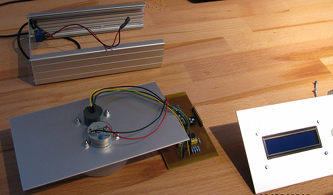
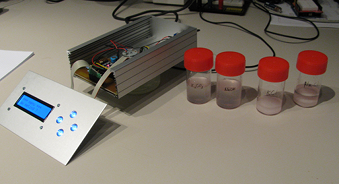
How long can you store food for? Just measure its water activity!

BetaWolf is a scientist fascinated by physics, chemistry,  mathematics and especially the symmetry of phenomena in nature and the way humans describe them in the form of fundamental laws. He submitted to our blog a project focused on measuring water activity powered by Arduino Pro Mini :

Water activity? And why would I want to measure it? Food always contains a certain amount of ‘free’ or unbound water. The more unbound water is present, the easier it is for micro-organisms like fungi to grow. Hence, the shelf life of food products is shortened by the presence of unbound water. Water activity is a physical quantity that describes the amount of unbound water in a product. Therefore, by measuring the water activity, you can estimate the shelf life of food. Only problem is the incredible amount of money you have to pay for a commercial water activity meter. In this article I describe an easy and cheap water activity meter on the basis of a humidity sensor, an NTC, and an Arduino Pro Mini.

Check his blogpost for all the details about this project.

Arduino Blog 31 Jul 22:18
arduino  featured  food  

Why the NSA Can’t Listen to His Mixtape – Interview with David Huerta

David Huerta is a technologist who recently published a provocative work to make everyone think a little bit more about privacy and what governments should be allowed to do or not:

I work outside the Pokemon business model of catching every user’s data or abusing it for state surveillance. I work instead surrounded by priceless art and in giving it a voice inside and outside the thick, Faraday cage walls of the museum it lives in.

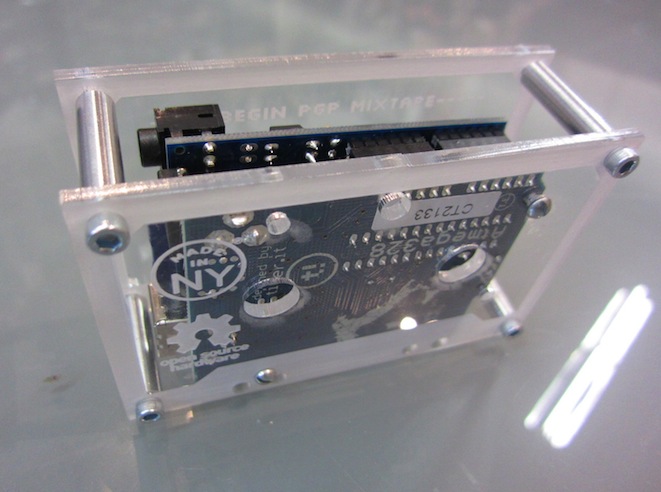
He created an encrypted mixtape and sent it to NSA. The device runs on Arduino and other open hardware and for David is a:

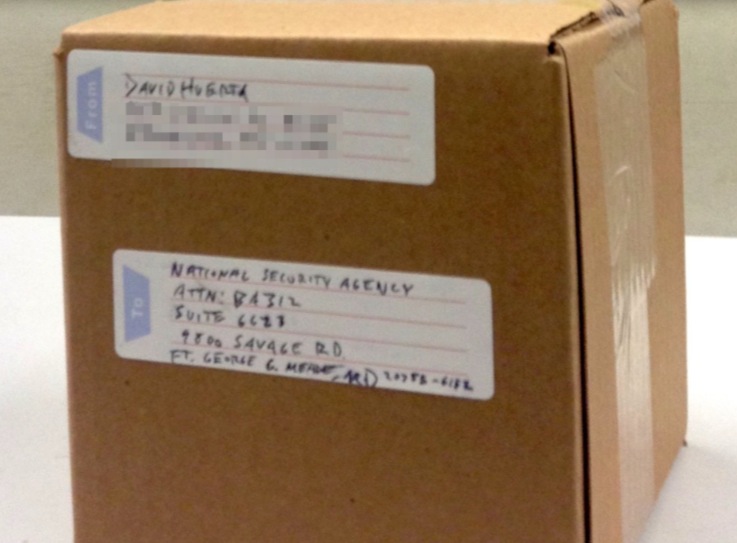
machinery that can be trusted not to spy on you because of the disclosure of its design, schematics and bill of materials to anyone who wishes to inspect, build, or build upon the device. The device contains a soundtrack for the modern surveillance state. It’s designed to be enjoyed only by people I have consented it to be listened to. A second copy of this device will also be sent to the NSA’s headquarters in Maryland, but without the private key needed to decrypt it; a reminder that the rules of mathematics are more powerful than the rules of even the most powerful states.

We got in touch with him and was happy to answer a couple of questions for the blog:

Z: What makes you more uncomfortable about NSA actions which made you react and build this device?

D: The NSA’s mass surveillance encompasses a lot of programs which run counter to what I feel is a fundamental right to privacy. In the US Constitution there’s an expression of that in its fourth amendment.
What the NSA is doing goes against the spirit of that much like petting a cat backwards; It’s the wrong direction to go towards and a cat/society will swipe its paw at the offender.
Z: Arduino community is always interested in understanding how things are made. Where we can find source code and technical specs to build one? It would be great if we all could share more practical knowledge on these topics.

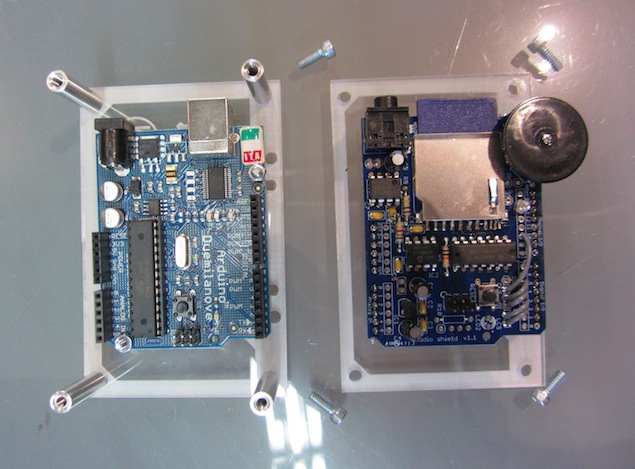
D: The mixtape device is basically just an Arduino and Adafruit wave shield. The code to play each wave file on the SD card on a loop (when unencrypted) is right off their list of examples.
I made one slight modification, which is to turn on a purple LED to indicate when it’s working. Purple is not an easy LED color to source, but it’s the global Pirate Party color and I wanted to give them subtle props for working towards a free and secure internet on the policy side of things.

I will at some point publish a way to do the encryption part of this using a Beaglebone Black and CryptoCape to make it a fully open hardware proof-of-concept, but in this case the SD card encryption was done off-device. I also plan on going through a full tutorial based on that at this year’s Open Hardware Summit in Rome.

Z: You said: “The NSA can read my stupid Facebook updates but without my consent it will never be able to listen to my kick-ass mix tape, even if it’s sitting right in front of them.” – What makes you believe that your encryption is strong enough?

D: The truth is that everyone sucks at information security, including myself, so no one can really make the claim something they’ve built is “NSA-proof.” Generally though, the less hardware and software you have, the less complexity and thus, opportunity for attack vectors or human errors there are. The playlist was kept offline, is not on the Arduino sketch, or anywhere in the hardware except encrypted in the SD card. The only place the audio existed aside from in the various sources I collected it from was on the hard drive of the PC I used to compose the mix tape, which has since been removed and stored offsite and offline. The encryption was also ran by a different machine, and one that I generally keep on my person. This goes beyond mass surveillance capabilities and into TAO/FBI “partyvan” surveillance; I can’t imagine an intelligence analyst is going to go to their very serious boss to explain that they need to expense a vehicle to go after some guy’s mix tape in a city where they won’t even be able to find a parking spot close enough to run a tempest attack from.

ZDo you have the pictures of the inside showing the components and the circuits?

D: They’re not too exciting since its just the Arduino + Wave Shield, but I attached a photo of the unencrypted version (clear acrylic instead of red clear acrylic), which I’ll also be bringing with me to the Open Hardware Summit.
 

Looking forward to meet him at Open Hadware Summit!

Arduino Blog 30 Jul 07:50

Fritzing is out with a new release including Arduino Yún microcontroller!

Fritzing is an open-source hardware initiative that makes electronics accessible as a creative material for anyone. You can easily learn how to build a circuit for you project and also design your own PCB.

Last week, the Fritzing team announced the new release with a number of new parts, especially a number of popular microcontrollers, among which also Arduino Yún:

We have upgraded to their latest version Qt5, which brings stability and speed improvements (especially for Mac OS X users). This also enables us to port fritzing to Android, iOS, etc.

You can download Fritzing 0.9.0b at this link.


Arduino Blog 28 Jul 16:39

Two steampunk espresso machines running on Arduino Mega

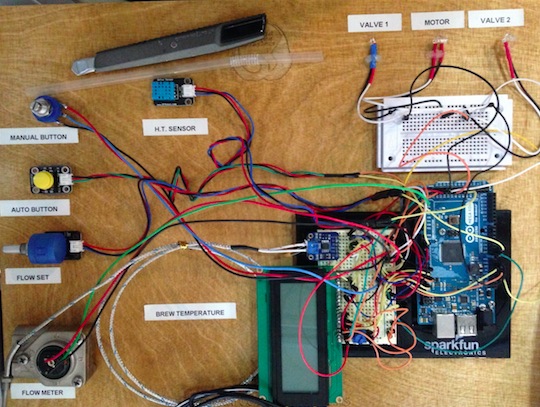
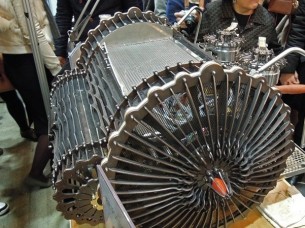
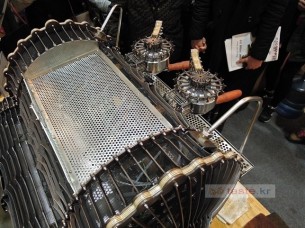
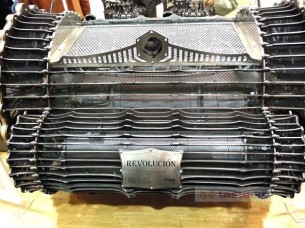
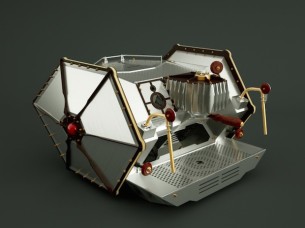
There’s a team of designers based in Korea who are passionate about coffee machines. Their name is Vidastech and recently shared with us two new hand-assembled machines prototyped  with Arduino Mega called Hexagon and Revolucion.

Take a look at the gallery for more pictures:


Arduino Blog 22 Jul 15:50

Share hyperlocal air pollution data with Sensing Umbrella

The Sensing Umbrella is the second project I’m featuring on this blog (see the first), coming out of the class at  the Copenhagen Institute of Interaction Design called Connected Objects, with Massimo Banzi and Giorgio Olivero. 

The project created by a team of students Akarsh Sanghi, Saurabh Datta and Simon Herzog is a platform to gather, display, and share hyperlocal air pollution data:

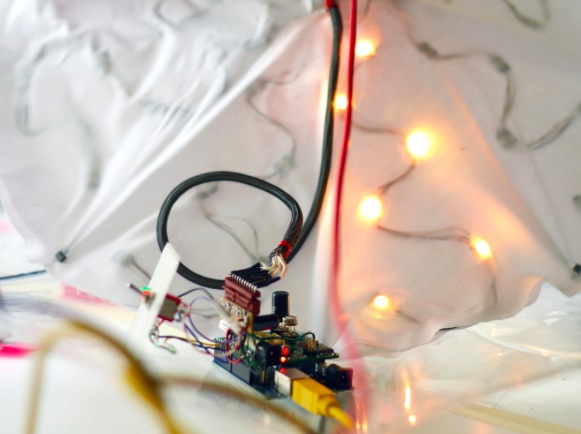
Each umbrella serves as a node for measuring CO and NO2 pollution levels and can provide exceptionally granular data to pollution databases and for scientific analysis. Simultaneously, the light visualisations inside the umbrella respond to pollution levels in real time and spread awareness of air quality in the city for its inhabitants. The umbrella uses open hardware and software to gather and interpret data through a built-in sensor array, displays CO and NO2 pollution locally in two modes, and logs the timestamped and geolocated data to the cloud for analysis.

Check the video to watch the team introducing the project:

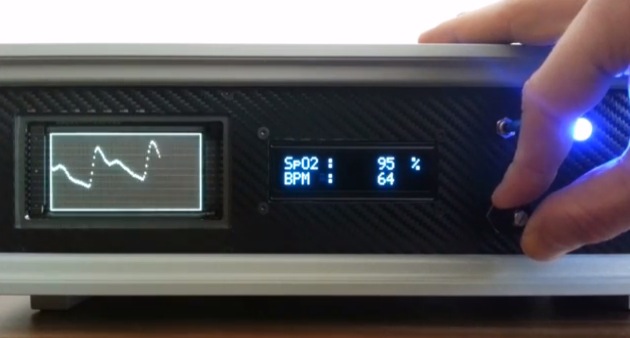
DIY Pulsoximeter developed with two Arduino

Pulse oximetry is a non-invasive method for monitoring if a patient’s oxygenation is unstable and Arduino user die_Diode sent us his version of a DIY Pulsoximter developed with two Arduino:

Arduino Mega for the oximetry electronics and Arduino Uno for the graph.
The electronics includes LED Driver, Photo current transformation, patient-dependent calibration LED, Active filters, Nellcor SpO2 sensor. Adafruit OLED displays Vitalparamter. Noritake VFD display GUU-100 shows the PPG. The boards are connected to the electronics with a Protoshield.

Arduino Blog 15 Jul 21:41

Spraying natural fibers to build cotton-candy surfaces

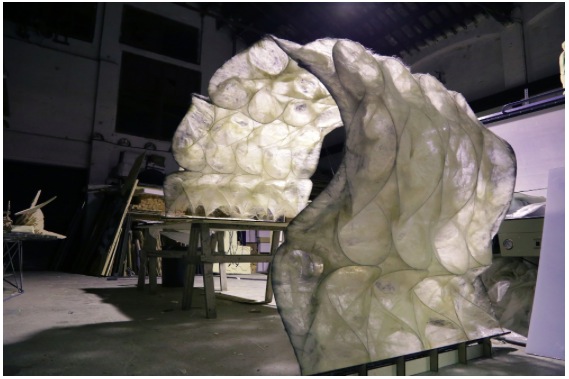
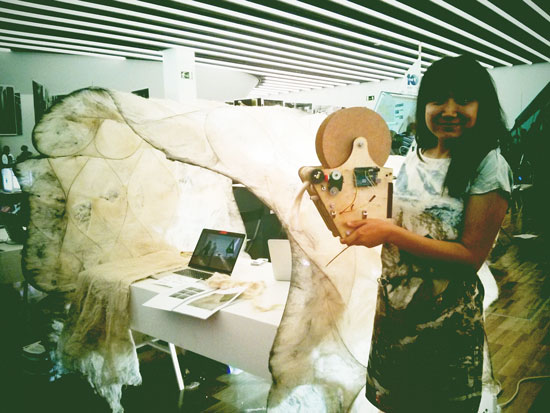
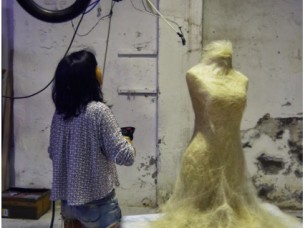
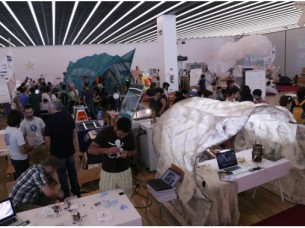
During Fab10 Fab Festival in Barcelona I met Jin Shihui who introduced me to CandyProject, a research project exploring the process of spraying natural fiber to create a non-woven textile that can be used to produce anything from building components to ornamental artifacts.

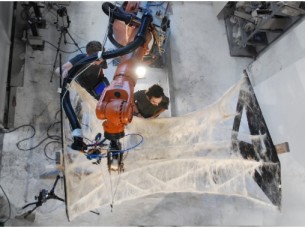
By means of air pressure we separate the fibers from a roving allowing them to self-organize and reassemble due to the surface tension caused by a fine mist of adhesive. This creates a controlled fibrous aggregation producing an emergent morphospace encompassing the initial substructure.

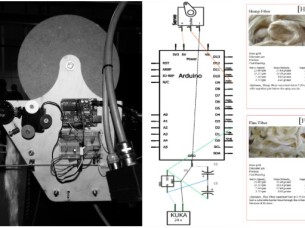
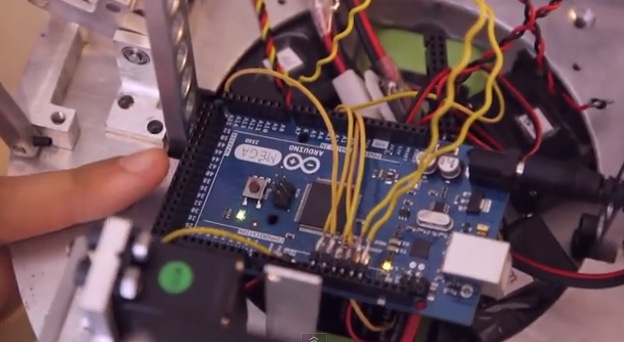
The robot Jin is holding in her hands in the picture above uses air pressure to separate fibers into individual strands. While the fibers are still separated they are embedded with an adhesive spray and all parameters are controlled within the robot  with an Arduino Uno:

Designing an end effector for the robot to precisely spray the fibers allowed us to predefine the spraying protocol of any object, while also modifying the material properties at each of its parts. Varying degrees of material density, thickness, and rigidity could be achieved by simply adjusting certain parameters in the spraying process while always insuring repeatability and precision. Controlling these properties, coupled with the environmental and thermal nature of the fibers used, opens up a wide range of possible applications ranging from optimized building envelopes to furniture and custom made fashion. We want to share details of our project  so everyone can  build your own spraying tool and develop your usage with this technic.

Take a look at the video below showing the whole amazing process from growing to spraying the fibers:

Some other pictures:


Freefall camera: an autonomous skydiving robot

A group of skydivers and engineers, combined their passions to create the world’s first autonomous skydiving robot, equipped by a camera and controlled by Arduino Mega.

The Freefall Camera is a student project at the University of Nottingham, its team is composed by David Alatorre, Tom Dryden, Tom Shorten and Peter Storey who received the third prize at the Student Venture Challenge from the Haydn Green Institute for Innovation and Entrepreneurship.

Their robot freefall camera is already in testing phase and the team features in a number of videos created by the University’s Nottingham Science YouTube channel.

Take a look at the video below explaining how they used Arduino Mega and enjoy the whole playlist at this link.

Arduino Blog 02 Jul 22:17

Aluminalis: Our 16-legged Walking Creature

“Let’s build something creepy, Dad…”, my teenage daughters said. We had no idea this creepy crawly creature would utilize our machining skills to the fullest.

Read more on MAKE

Monitor the Health & Vitality of Your Home Garden with Weekend Projects

Two Weekend Projects from our archives are ideal for challenging makers to hack their houseplants and collect data from their garden.

Read more on MAKE