Posts with «arduino» label

Helmet of many LEDs built for Burning Man

This motorcycle helmet was heavily altered to accept all of the hardware that goes into driving that huge array of LEDs. [Brian Cardellini] built it to wear at burning man. He claims to have been in over his head with the project, but we certainly don’t get that feeling when we see the thing in action. It’s light on build details, but there are plenty of demo shots in the video after the break. The animation and fading action really gets started about a minute and a half into it.

One of the early frames of the video is a shot of the parts order webpage. Since it’s an HD clip we were able to glean a few bits and pieces from that. It includes a MAX7219 LED Display Driver and fifteen 25-packs of Blue LEDs. Now that chip is a great choice, and one of the later shots shows two of them on breakout board driven by an Arduino. The look is very clean since he carved out most of the helmet’s padding to make room for the electronics.

[via Adafruit]


Filed under: led hacks, wearable hacks

16×8 pixel laser projector

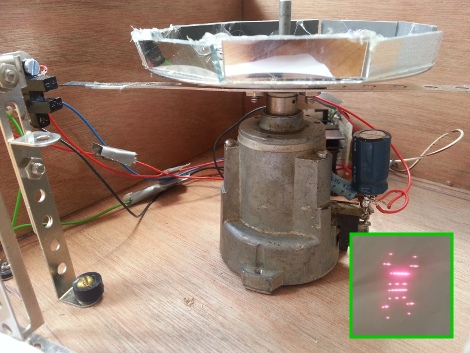
[Michiel] gave us a little shout-out by drawing the Hackaday logo with his recently completed 16×8 pixel laser projector. It uses a spinning set of mirrors mounted at slightly different angles to redirect the path of the red laser diode.

The projector is driven by an Arduino. To give it more than just a hard-coded existence [Michiel] included an Xbee module. This lets him connect to it with a computer in order to stream messages. One of the demo videos linked in his project log shows the web interface he coded which will push a message typed in the submission form out to the projector where it is scrolled like a marquee.

This type of spinning display is one of a few common methods for making laser projectors. In the image above you can see the optical sensor which is used to sync the diode with the spinning mirrors, each of which is responsible for a different row of pixels. He lists off several things that he learned when working on the project. We think the most important is the timing issues which go into something like this.


Filed under: laser hacks
Hack a Day 14 Sep 23:01

Brabenec

Primary image

What does it do?

follow wall/avoid obstacles

Overview

We are building this robot with my friend. It is (when finalized) supposed to be able to detect metal objects and interact with them (move them, ideally...). So far it has only two IR sensors for obstacle detection, so no metal detection.


Cost to build

Embedded video

Finished project

Number

Time to build

Type

tracks

URL to more information

Weight

read more

Arduino quadruped robot

Primary image

What does it do?

Walk forward and backword

Hi all,

I’ve been working on my first real robot last week-end and wanted to share it. It’s a simple quadruped arduino robot controlled by serial (via USB). Videos can be viewed on my blog : http://blog.joomun.org/2012/09/09/arduino-quadruped-robot/

The robot structure has been created with cheap mecanno clone

IR control has been added, i'll update the blog later.

Cost to build

$66,00

Embedded video

Finished project

Number

Time to build

10 hours

Type

legs

URL to more information

Weight

300 grams

Intel's Core i3 NUC mini-boards set to hit market in October, power up hobbyists and OEMs

Intel has finalized the specs of its Next Unit of Computing (NUC) board, and announced it'll go on sale in October for less than $400 with a case and power supply. Carrying a 4 x 4-inch form factor between a Raspberry Pi and mini-ITX board, it'll be equipped with a Core i3 Ivy Bridge processor, HD 4000 graphics, two SO-DIMM sockets, an M-SATA slot for an SSD drive, three USB ports, one HDMI port and a mini-PCI slot for wireless connectivity. Two different models will be offered by the chip giant, identical except that one will be Thunderbolt equipped and the other will sport an ethernet port for connectivity. Originally intended for the kiosk and signage markets, enthusiast interest compelled Intel to put the board on general sale, along with a case (pictured above) and power supply option. That'll pit it against offerings from VIA and others, while offering considerably more oomph in a similar form factor -- though a mini-server slaying Core i5 option originally proposed by Intel was dropped.

[Image credit: PC World]

Filed under: Desktops, Misc

Intel's Core i3 NUC mini-boards set to hit market in October, power up hobbyists and OEMs originally appeared on Engadget on Thu, 13 Sep 2012 12:31:00 EST. Please see our terms for use of feeds.

Permalink | Email this | Comments

A.I. X1

Primary image

What does it do?

Learns to navigate

This is my first experiment with artificial inteligence using a simple Doodle Bot with a RTC and SD card for extra memory. When I say artificial inteligence I am not talking about a supercomputer that you can discuss philosophy with over a cold beer.  Simply a robot that will try to learn from past experience as previously discussed in my blog: http://letsmakerobots.com/node/34177

Cost to build

Embedded video

Finished project

Number

Time to build

Type

URL to more information

Weight

read more

New in the Maker Shed: NFC Shield and Tags

You’ve probably heard about NFC but what is it, you ask? NFC (Near Field Communication) is an extension of RFID (Radio Frequency Identification) but with a purposefully decreased range. I know, why would you want LESS range? Mostly for security. You see, it’s common to think that RFID tags need to be right next to a reader before they register. In lots of cases this is true, but you can “shoot” a radio signal at an RFID tag or purchase a long range scanner to read it if from a distance. Since NFC is limited to a maximum of around 4 inches, it’s much more difficult for anyone to get your information without you knowing. This makes it a great technology to use for touch-less payment, door entry, or anywhere else that security is a consideration.

This NFC Shield for Arduino (available in the Maker Shed) is a great way to experiment with NFC and other 13.56MHZ RFID applications. The shield can be used it to not only read tags, but to write them as well. It can even “act” as an NFC tag for bi-directional communication with NFC equipped cell phones and tablets. The NFC Shield uses I2C or SPI for communication to minimize pin usage, and the antenna design improves reception and allows you to stack shields on top of it. The kit includes header pins (a little soldering required) and one writable MiFare 1k 13.56 MHZ NFC card. Since one card isn’t too much fun, we also have an assortment pack of 6 writable, 1KB tags available.


Filed under: Arduino, Cellphones, Maker Shed
MAKE » Arduino 12 Sep 16:00

The Inebriator Cocktail Machine

The Inebriator is a sweet Arduino-powered cocktail machine. Cool, right? Interestingly, there is a twist where the creators are declining to reveal a BOM or source code, and there’s a minor fracas on the site in comments. This is certainly their right, but it seems an oddity in this era of open source hardware. Or maybe I’ve just drunk too much MAKE-ade? Leave a comment with your thoughts.


Filed under: Arduino, Open source hardware

Ben Heck fashions a pocket computer with an Xbox Chatpad and Arduino Uno

It's great to see Ben Heck focus his efforts of do-gooder projects like that foot-controlled wheelchair, but we'll always have a soft spot for the modfather's more nostalgic undertakings, like this BASIC pocket computer. Heck created the device for the latest episode of his web show, and if you're following along at home, you'll need the Chatpad from an Xbox 360 controller, an Arduino Uno and a LCD display -- a Hitachi HD 44780, in this case. The modder-turned-host is quick to point out that the project's purpose isn't solely nostalgic -- you can also use it to control real world objects, which in the Heck's case means a ghost on a pinball playfield. Check out a video of the invention in action after the break.

Continue reading Ben Heck fashions a pocket computer with an Xbox Chatpad and Arduino Uno

Filed under: Misc

Ben Heck fashions a pocket computer with an Xbox Chatpad and Arduino Uno originally appeared on Engadget on Mon, 10 Sep 2012 22:04:00 EST. Please see our terms for use of feeds.

Permalink | Email this | Comments

Bits and Peices Robotic Arm

[V0R73X], who is 17  has been working on a project, to build A robotic arm. This project started out as a challenge put forward from one of his school teachers to build a robotic arm for $200.  [VoR73X] accepted, and the challenge began.

He came up with a robotic arm that can be controlled from his mobile phone and other bluetooth enabled devices. He also designed it so that he can control it from the infrared remote control of an old tv set. [VoR73X] decided to kept the design simple, to make it easy for others to build.  [VoR73X] has shared the code and a step by step process of how to build in the hopes that others would also like to take up the challenge.  Watch the video after the break for further details on his project.

via[Instructables]


Filed under: arduino hacks, robots hacks
Hack a Day 10 Sep 17:01