Posts with «arduino» label

Insert Coin: Tabber lights up your fretboard, shows you the way to rock

In Insert Coin, we look at an exciting new tech project that requires funding before it can hit production. If you'd like to pitch a project, please send us a tip with "Insert Coin" as the subject line.
The idea of a lighted fretboard isn't a new one by any stretch (how do you think the Fretlight got its compound name?), but there's something to be said for not having to buy a brand new guitar for that functionality. The folks behind Tabber are working to make that a reality, having tested a number of prototypes for a product that you can simply slip over the neck of your axe for a quick tutorial. The company is looking to create a slicker version of the concept that it can bring to the market. Tabber's creators need your help to "transform the guitar industry," so naturally they've taken to Kickstarter, with a little under a month to hit their $45,000 goal. The Arduino-powered LED guitar instructor will connect to a mobile device via Bluetooth, accessing information to let you play along with songs, figure out chords and bend your fingers around some scales. Click the source link to send some cash Tabber's way, or to find out a bit more about the project.

Update: As a number of commenters have pointed out, there's a similar project currently awaiting your donations on Kickstarter. Great minds, huh?

Continue reading Insert Coin: Tabber lights up your fretboard, shows you the way to rock

Insert Coin: Tabber lights up your fretboard, shows you the way to rock originally appeared on Engadget on Thu, 22 Mar 2012 11:00:00 EST. Please see our terms for use of feeds.

Permalink | Email this | Comments

Creating a new Arduino PCB in the Arduino IDE - Trials and Tribble-ations

If someone can help me out then I will write a tip/walkthough on this subject.

Quite often DAGU products use the ATmega168 MCU rather than the ATmega328 because they are a bit cheaper and 16K of program memory is often enough.

The problem is that ATmel no longer produce the ATmega168 20-AU which we had been using. They now produce the ATmega168PA which is almost identical but has a different device signature ID.

read more

Let's Make Robots 22 Mar 07:22
arduino  avr  boards  bootloader  new  pcb  signature id  

IOIO, another cool physical computing project

Over at Engineer Blogs, I found out about another cool project for connecting computers up with the real world—the IOIO (pronounced yo-yo):  An Interview with Ytai Ben-Tsvi, Inventor of the IOIO.

Basically, it is a $50 IO board for an Android phone, using either USB or Bluetooth connection, controllable with a Java API from an Android 1.5 or later device.  It has a PIC24F microcontroller providing 48 I/O pins, which have the usual sorts of capabilities (PWM, I2C, SPI, …).  You can use it in much the same way you would use an Arduino, except that you need an Android device to talk to it.

This is a plus and a minus, as the Android phones come with a fair amount of compute power and some powerful software (like face recognition software), but they cost a lot also, and you wouldn’t want to tie up your phone in a dedicated project (a $25 Arduino board is cheaper to embed than a phone and a $50 IOIO board).

I don’t think that the Android phone+IOIO is quite as exciting as the $35 Raspberry Pi if you need cell-phone-level compute power, but it looks like a good way to make cell-phone-controlled gadgets.


Tagged: Android, Arduino, IOIO, PIC24F, Raspberry Pi

Old style tweet printing machine

The Twittertape Machine prototype from Adam Vaughan connects to his Twitter account via Ethernet, checks for updates twice every minute, and prints out a hard copy of any new Tweets without the need for printer ink.

Vaughan told us that the idea for the Twittertape Machine was born of a desire to have the kind of old stock ticker seen in movies sitting on his desk. After a lukewarm reception to his pitch from friends, he decided to make his dream a reality. Rather than sacrifice a rare original (like the Edison Universal Stock Ticker used for Ames Bielenberg’s Spring Break project), he opted to build his own replica version from some old brass clock movements, a wooden plinth and a glass dome found online.

It is powered by two AC adapters and is controlled by a network-enabled Arduino-style microcontroller running custom code in the base. The board checks Vaughan’s Twitter account every 30 seconds for new Tweets.

The little thermal printer hidden at the base prints the tweets on a cut-down thermal paper. An awesome product in an awesome demand!

[Via: Twittertape and Gizmag]

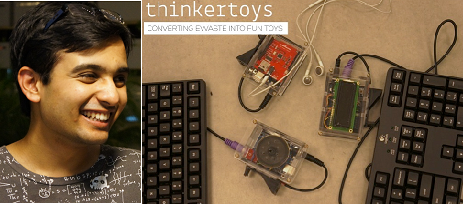
E waste to toys: ThinkerToys

Ever looked at a pile of E-waste containing perfectly usable electronic spare parts? Ever cringed at the thought of such aggregated piling waste from all the countries advancing in the field of technology? And all this waste being dumped in landfills in developing countries where kids who should be in school, work here for a meagre pay of a dollar a day.

Having seen this, ThinkerToys started as an idea to reuse this eWaste and convert them into fun toys for kids. The creations by Dhairya Dand,

a researcher at Keio-NUS CUTE Center, Singapore, was noticed by everyone at the ICTD (International conference on information and communication technologies and development), Atlanta 2012.

The design is simple: E waste + Arduino =

Keyano turns an ordinary keyboard into a piano! With the keys musically mapped to notes.

Basic addition, subtraction can be an invaluable skill for any kid. RandoMath is a small LED screen connected to your computer keyboard, and asks you random math puzzles.

Storynory has recorded fun stories in your local language, plug in the headphones or speakers for collaborative hearing.

Connect any old TV or CRT monitor and make it TV++, add a keyboard or a mouse for controls. This is a power packed mini computer designed for kids to be hooked on to the TV again, but this time for good reasons!

eWaste is directly connected to these toys without any modification. The resulting combination turns the eWaste (keybaord, mice, speakers, monitors) into something totally new and unexpected.

openTOYSis an ongoing project and more people might contact the creator for further development or for collaborating ideas. More of his works can be found here.

Arduino Blog 20 Mar 18:28
arduino  ewaste  toys  

Maker from India: Anirudh Sharma

A former student of a college located in the town Bikaner, Rajasthan(India), Anirudh Sharma (twitter, blog) is a maker with a lot of perseverance. His first project Sparsh (Video) during college days generated a lot of interest in the Indian Maker community. His regular work at HP labs as a consultant, and his most famous recent work which was presented at TEDx BITS, Goa, the shoe for the blind – Le-chal, has brought him to the attention of makers around the world.

The latest was him getting featured in the MIT Technology Review, India TR35 list as a ‘young technology innovator’ followed by a call to pursue further studies with MIT Media Labs.

A casual chat-up with him threw light on the way open source hardware is affecting the lives of independent makers of India.


Priya: Congrats Anirudh! How does it feel to be featured in MIT list of young inventors?

Anirudh: Feels great that our work is being recognized at that level. Its a great platform to meet other people in doing technology related work.
Priya: Could you explain the project that was featured for our readers?
Anirudh: Codenamed as le´ chal, it’s a way of communicating navigational information with an intuitive eye-free interface. We used pizeo vibrational actuators in the four sides of the shoe that ‘poke’ the user about the direction he needs to walk in. The system could fit within a shoe. The reason we used a shoe is because it is something that we can repeatedly use in our day to day lives. We’ve started a company – Ducere Technologies [website yet to be up] to take this forward as a full fledged product.
Priya: Which specific area interests you the most in the field of electronics?
Anirudh: [I am] Not much of an electronics guy, I started fooling around with transducers back in 2010. I like the research going on in area of MEMS/Biomechatronics though.
Priya: What prompted you to use Arduino?
Anirudh: [Laughs] Not being an electronics guy, Arduino was the easiest way for me to start prototyping. The high-level easy access to sensor data pushed me to choose this platform to begin with.
Priya: So, MIT media labs that is big! What do you plan to study there?
Anirudh: Not thought yet. I’d love to explore tangible input to CAD systems, Raskar’s NETRA project which creates an inverse Shack-Hartmann sensor. This compiles to new hardware add-on to mobile phones for instant eye-prescription data. Other projects that interest me are AutoStereoscopic displays-BiDi screen, similar to explorations I did with my mentor ‘SriG‘(Sriganesh Madhvanath) at HP Labs.
Priya: I see that you have taken initiatives for the blind, what other areas can you see open source hardware solving problems?
Anirudh: If you’ve an idea that could touch lives, there’s nothing better than open source hardware to start your explorations with, as it not only provides the right tools but a community backing that you could rely on.
Priya: Any special blogs/people that you follow in the field of technology?
Anirudh: [I follow the works of] Arduino, MIT Tech Review, Seth Sandler, Bret Vitor, Aza Raskin, ladyada for it brings out fresh insights. In general, I admire works of VS Ramachandran, Feynman, Shwetak Patel and Bill Buxton.
Priya: Any other hobbies other than tinkering?
Anirudh: I play Portal 2, FarCry, trek to new places, and do photography.

Arduino Blog 19 Mar 16:13
arduino  education  hacks  india  lilypad  

Sphero goes modular, spins out for a drive (video)


Sphero's hooked up with a new whip, albeit a retro-fitted one. Skylar, a Junior Developer at Orbotix, modded an old RC car with an Arduino board, H-bridge and a few trackball parts, enabling the remote control ball to serve as its brain. Just in time too -- there's only so much fun you can have getting the little orb stuck behind the filing cabinets. Still, it's certainly a leap beyond purposing it to pull an iPhone-toting chariot.

Sean Buckley contributed to this post.

Sphero goes modular, spins out for a drive (video) originally appeared on Engadget on Mon, 19 Mar 2012 02:36:00 EST. Please see our terms for use of feeds.

Permalink | Email this | Comments

SpiDuino

Primary image

What does it do?

Navigates via Ultrasound, annoys the dogs

"SpiDuino" because of course it's Arduino for brains, and if you watch the end of the video it tries to climb up the wall.  Gets about to 90 degrees, too.  This is a variation on the "Start Here" robot that this site is famous for.  Essentially I wanted to test the base and the SN754410, which I was having trouble with and noted in this node.  Obviously I got it going, but special thanks to ChrisTheCarpenter and Kyle (birdmun) for their guidance.

Cost to build

$90,00

Embedded video

Finished project

Complete

Number

Time to build

1 hour

Type

URL to more information

Weight

read more

Arduino RC Car

Primary image

What does it do?

Drives and avoids obstacles

I had bought a RC Car from walmart for about $15 to use with the Arduino Motorshield a while back (see here). Fortunately, I had taken some pictures before I removed the RC receiver circuit from it. Turns out that its lot more efficient to use the onboard controller along with an Arduino instead of using a motorshield. I didnt some research and found out that many “cheap” RC cars use the same Realtek TX2 & RX2 chips inside. I was lucky enough to find the same inside this RC car.

Cost to build

Embedded video

Finished project

Number

Time to build

Type

URL to more information

Weight

read more

kedairobot.com - robotics shop in Indonesia