Microsoft will shut down AltspaceVR on March 10th

Microsoft is narrowing its metaverse ambitions. In a blog post spotted by VentureBeat (via The Verge), the company announced it would shut down AltspaceVR, the social virtual reality platform the company acquired in 2017, on March 10th, 2023. Microsoft attributed the decision to a desire to focus on Mesh, the mixed reality platform the company announced in 2021 and later said would come to Teams.

“We look forward to what is to come, including our launch of Microsoft Mesh, a new platform for connection and collaboration, starting by enabling workplaces around the world,” Microsoft said. “In the near term, we are focusing our VR efforts on workplace experiences, learning from and alongside our early customers and partners, and ensuring we deliver a foundation that enables security, trust and compliance. Over time, we hope to extend to consumer experience[s] a[s] well."

News of the shutdown comes after Microsoft confirmed it would lay off 10,000 employees through the end of March. According to Windows Central, Microsoft plans to cut the entire AltspaceVR team as part of the reorganization. Per Bloomberg, the company also reduced the headcount of its HoloLens team. Over the past year, the division has seen the departure of former head Alex Kipman, who left Microsoft in June amid allegations of sexual misconduct, and the pause of a purchasing agreement with the US military. In 2022, Microsoft also reportedly abandoned plans it had for a new HoloLens device.
Meta takes Ukraine’s controversial Azov Regiment off its dangerous organization list

Facebook parent company Meta has removed the Azov Regiment, a controversial unit within the Ukrainian National Guard with far-right political leanings, from its list of dangerous individuals and organizations. The move, first reported by The Kyiv Independent, means members of the unit can now create Facebook and Instagram accounts and post without Meta automatically flagging and removing their content. Additionally, unaffiliated users can praise the Azov Regiment, provided they abide by the company’s Community Standards.

“The war in Ukraine has meant changing circumstances in many areas and it has become clear that the Azov Regiment does not meet our strict criteria for designation as a dangerous organization,” a company spokesperson told The Kyiv Independent. Meta did not immediately respond to Engadget’s comment request.

Sharing more information on the policy change, Meta told The Washington Post it recently began to view the Azov Regiment as a separate entity from other groups associated with the far-right nationalist Azov Movement. Specifically, the company pointed to Ukraine's National Corp political party and founder Andriy Biletsky, noting they’re still on its list of dangerous individuals and organizations. “Hate speech, hate symbols, calls for violence and any other content which violates our Community Standards are still banned, and we will remove this content if we find it,” Meta said.

Important news from @Meta — changes in platform’s policies. Azov regiment no longer meets designation as dangerous organization. Means a lot for every Ukrainian. New approach enters the force gradually. Big contribution @nickclegg & his team in sharing truthful content about war.

— Mykhailo Fedorov (@FedorovMykhailo) January 19, 2023

The Azov Regiment was founded in 2014 by Biletsky following Russia’s annexation of Crimea and the start of the Donbas War that same year. Before the unit was integrated into Ukraine’s National Guard in November 2014, it was controversial for its adherence to neo-Nazi ideology. In 2015, a spokesperson for the Azov Regiment said 10 to 20 percent of the unit’s recruits were self-professed Nazis. At the start of the 2022 conflict, Ukrainian officials said the Azov Regiment still had some extremists among its ranks but claimed the unit had largely become depoliticized. During the months-long siege of Mariupol, the Azov Regiment played a prominent role in the city’s defense. Russia captured many of the battalion’s fighters at the end of the battle.

The change underscores just how much Meta’s content moderation policies have changed since the start of Russia’s invasion of Ukraine. Partway through last year, the company began temporarily allowing people in Ukraine and a handful of other countries to call for violence against Russian soldiers. After the decision created controversy, Meta said it would turn to the Oversight Board for policy guidance, a request the company later withdrew, citing “ongoing safety and security concerns” related to the war.

An Open Hardware Automatic Spinning Machine

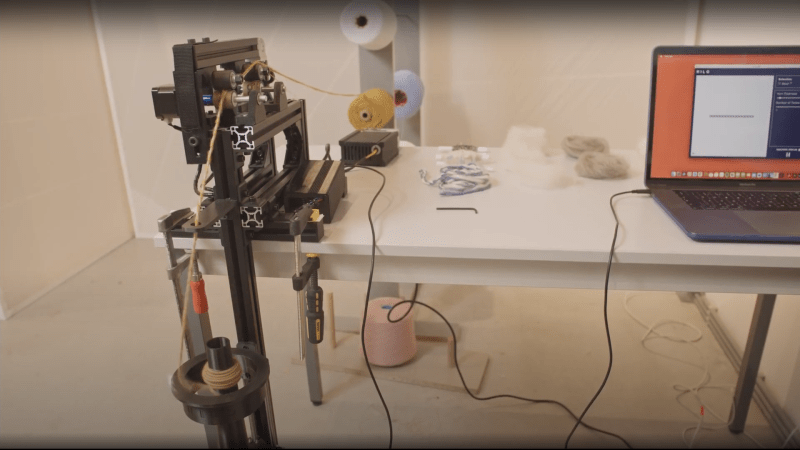
The team at the Berlin-based Studio HILO has been working on ideas and tools around developing a more open approach to small-scale textile production environments. Leveraging open-source platforms and tools, the team has come up with a simple open hardware spinning machine that can be used for interactive yarn production, right on the desktop. The frame is built with 3030 profile aluminium extrusions, with a handful of 3D printed, and a smidge of laser cut parts. Motion is thanks to, you guessed it, NEMA 17 stepper motors and the once ubiquitous Arduino Mega 2560 plus RAMPS 1.4 combination that many people will be very familiar with.

The project really shines on the documentation side of things, with the project GitLab positively dripping with well-organised information. One minor niggle is that you’ll need access to a polyjet or very accurate multi-material 3D printer to run off the drive wheel and the associated trailing wheel. We’re sure there’s a simple enough way to do it without those tools, for those sufficiently motivated.

We liked the use of Arduino for the firmware, keeping things simple, and in the same vein, Processing for the user interface. That makes sending values from the on-screen slider controls over the USB a piece of cake. Processing doesn’t seem to pop up on these pages too often, which is a shame as it’s a great tool to have at one’s disposal. On the subject of the user interface, it looks like for now only basic parameters can be tweaked on the fly, with some more subtle parameters needing fixing at firmware compilation time. With a bit more time, we’re sure the project will flesh out a bit more, and that area will be improved.

Of course, if you only have raw fibers, that are not appropriately aligned, you need a carder, like this one maybe?

Thanks [Daniel] for the tip!

Twitter is working on an ad-free subscription tier

Twitter is working on a new, more expensive Blue subscription tier that will allow users to browse the platform without seeing ads. “Ads are too frequent on Twitter and too big. Taking steps to address both in coming weeks,” Twitter owner Elon Musk tweeted on Saturday afternoon. “Also, there will be a higher priced subscription that allows zero ads.”

In the US, Twitter Blue currently costs $11 per month when users subscribe directly through the Twitter iOS or Android app. On the web, where Apple and Google’s up to 30 percent commission on in-app purchases doesn’t apply, the service costs $8 per month. Since Twitter began revamping the subscription in November, the ability to see fewer ads on your timeline has been one of the primary selling points the company has pushed, but that perk is still listed as “coming soon” when you go to sign up for the service.

Also, there will be a higher priced subscription that allows zero ads

— Elon Musk (@elonmusk) January 21, 2023

By some estimates, Twitter’s ad revenue has declined precipitously since Musk’s takeover of the company in October. According to a recent report published by The Information, a senior Twitter manager told employees this past Tuesday that daily revenue was down 40 percent from the same day a year ago. One internal slide seen by the outlet saw Twitter attribute the decline to the initial relaunch of Twitter Blue, which saw the platform overrun by verified trolls who used the paid verification feature to impersonate brands, celebrities and other notable accounts.

FTC asks court to hold Martin Shkreli in contempt for launching new drug company

Martin Shkreli, whom you may know as "Pharma Bro," launched a new company last year called "Druglike, Inc." Now, the Federal Trade Commission (FTC) has asked a federal judge to hold him in contempt for failing to cooperate with the agency in its investigation to determine whether launching the company violates his lifetime industry ban. US District Court Judge Denise Cote imposed a lifetime ban on Shkreli that prohibits him from participating in the pharmaceutical industry early last year. Cote ruled that the former pharma exec orchestrated an illegal anticompetitive scheme to gain a monopoly over Daraprim, a life-saving anti-malarial and anti-parasitic drug. 

After Shkreli's former company, Turing Pharmaceuticals, obtained the manufacturing license for Daraprim, it raised the drug's prices from $17.50 to $750 per tablet. Cote sided with the FTC in the antitrust lawsuit the agency filed against Shkreli in 2020 and ordered him to pay $64.6 million in damages, in addition to imposing a lifetime industry ban against him. Prior to Druglike's launch, Shkreli tried (and failed) to convince a judge to put the ban on hold, arguing that the public could benefit from his future contributions to the industry. Shkreli challenged the ban while he was serving time in federal prison after receiving a seven-year sentence in 2017 for defrauding investors. He was released from prison in May.

The FTC said it started asking Shkreli for a compliance report and access to relevant records, as well as asking him to sit for an interview regarding Druglike, in October 2022. However, the company co-founder kept on disregarding its "repeated requests." The agency also said that Shkreli has yet to pay any amount of his $64.6 million fine. It's now asking the court to order Shkreli to comply with its information requests within 21 days of its decision. 

In a press release (PDF) for its launch, Druglike described itself as "a Web3 drug discovery software platform." The company said it's building a "decentralized computing network" that "provides resources for anyone looking to start or contribute to early-stage drug discovery projects." In a statement, Shkreli said "Druglike will remove barriers to early-stage drug discovery, increase innovation and allow a broader group of contributors to share the rewards."

‘Marvel’s Avengers’ won’t receive official support after September 30th

Following a two-year run that saw the game struggle for much of it, Crystal Dynamics is winding down the development of Marvel’s Avengers. Following a report of the project’s imminent demise, the studio published a blog post on Friday announcing it plans to stop supporting the live-service title after September 30th.

Crystal Dynamics will release one final balance patch and shut down Marvel’s Avengers in-game cosmetics store on March 31st. On that same day, players will see their remaining Credit balance converted to in-game resources, as shown in the chart below. Additionally, “as a show of our appreciation for our community,” Crystal Dynamics says cosmetics that were previously only obtainable through the marketplace will be free for all players who own a copy of the game.

Crystal Dynamics

After official support ends on September 30th, players can continue playing Marvel’s Avengers on their own and with friends over Xbox Live and PlayStation Plus. “The changes we are making to how the game functions will ensure as long a life as possible,” the developer said. “However, after September 30th, 2023 we can’t guarantee that we will be able to address issues that occur due to unforeseen circumstances.” Crystal Dynamics said it decided to end support for the title “in conjunction with our partners.”

The effective end of Marvel’s Avengers won’t come as a surprise to fans. In November 2020, two months after the game went on sale, publisher Square Enix said it had failed to recoup the cost of making the title. From that point forward, the company seemed reluctant to put any more money behind the project. Then, last May, Square sold Crystal Dynamics to Embracer Group. In December, the studio announced it was working with Amazon on a new Tomb Raider release. All of that seems to have factored into the decision to shut down Marvel’s Avengers.

Google lays off most employees part of its Area 120 incubator

Google's Area 120 division has been severely affected by the layoffs happening across Alphabet, according to Bloomberg and TechCrunch, which said the unit now has fewer than 100 employees after the most recent round of cuts. Area 120 is known as Google's in-house incubator, which works on experimental apps and products. Those include GameSnacks, an HTML5-based platform that enables users to load and play games quickly even on poor connections and basic smartphones. Sundar Pichai established the division in 2016 to "provide a purpose-built home for bottom-up innovation at Google." The division's website reads: "Area 120 teams work on new products, experiences, and services every day."

Alphabet recently admitted that it was cutting 12,000 jobs, which is around six percent of its global workforce. The layoffs "cut across Alphabet, product areas, functions, levels and regions," but it's bound to affect certain divisions more than others, seeing as the company performed "a rigorous review... to ensure that [its] people and roles are aligned with [its] highest priorities as a company."

A spokesperson told Bloomberg that the company has "made the difficult decision to wind down the majority of the Area 120 team." TechCrunch says the division typically works on 20 projects at any given time, but only three will "graduate" or will be folded into Google later this year. Almost everyone who isn't involved in those three projects has reportedly lost their jobs. 

During a round of cuts at Area 120 back in September, a Google spokesperson said that the division is "shifting its focus to projects that build on Google's deep investment in AI and have the potential to solve important user problems." It's unclear if any of the three "graduating" projects are AI-related or if the remaining team members are working on anything artificial intelligence. According to a recent New York Times report, though, Google is gearing up to show off at least 20 AI-powered products and a chatbot for search this year.

Elon Musk defends 'funding secured' tweets in Tesla shareholder trial

Elon Musk said that just because he tweets something, it "does not mean people believe it or will act accordingly." The Tesla chief took the witness stand in a San Francisco federal court to defend himself (and the tweets he made back in 2018) in a lawsuit filed by a group of the automaker's shareholders. "I think you can absolutely be truthful but can you be comprehensive? Of course not," he added, regarding Twitter's character limits. If you'll recall, Musk famously tweeted in August 2018 that he was "considering taking Tesla private at $420" and that he was already able to secure funding. "Investor support is confirmed," he said in a follow-up tweet.

The CEO later revealed that he was in talks with Saudi Arabia's Public Investment Fund, which reportedly expressed interest in Tesla as part of the country's bid to lessen its reliance on oil. However, the deal didn't materialize, and he later penned a lengthy post on the automaker's website to say that it's staying public. 

As CNBC notes, shareholders blamed those "funding secured" tweets for their significant financial losses, leading them to file a class action lawsuit against Musk. Tesla's shares apparently remained highly volatile in the weeks that followed. The executive, however, downplayed his tweets' impact and said that they don't necessarily affect stock prices: "There have been many cases where I thought that if I were to tweet something, the stock price would go down. For example, at one point I tweeted that I thought that, in my opinion, the stock price was too high...and it went went higher, which was, which is, you know, counterintuitive."

In addition to the shareholder lawsuit, the Securities and Exchange Commission sued Musk over his tweets, calling them "false and misleading statements" that could be constituted as fraud. Musk and Tesla paid $20 million each to settle with the SEC, and the executive had to step down as board chairman. The SEC also required company lawyers to approve any Tesla-related tweet Musk makes — a condition the CEO tried (and failed) to get out of last year. 

Aside from defending his tweets, Musk criticized short sellers during his testimony, telling the court that short-selling "should be made illegal." He added: "It is a means for, in my opinion, bad people on Wall Street to steal money from investors. Not good." Another piece of information to take away from his time on the witness stand is that nobody can tell Musk to stop tweeting. When lawyers asked him about the advice he got to refrain from posting on Twitter after calling a British cave diver a "pedo guy," Musk said: "I continued to tweet, yes."

According to Reuters, Musk only testified for less than 30 minutes and that he's not done answering lawyers' questions. He's expected to take the witness stand again to explain why he wrote the funding tweets and why he insisted that he had Saudi Arabia's backing. 

RP2040 DMA Hack Makes Another ‘CPU Core’

[Bruce Land] of Cornell University will be a familiar name to many Hackaday readers, searching the site for ‘ECE4760′ will bring up many interesting topics around embedded programming. Every year [Bruce] releases yet more of the students’ work out into the wild to our great delight. This RP2040-based project is a bit more abstract than some previous work and shows yet another implementation of an older hack to utilise the DMA hardware of the RP2040 as another CPU core. While the primary focus of the RP2040 DMA subsystem is moving data between memory spaces, with minimal CPU intervention, the DMA control blocks have some fairly complex behaviour. This allows for a Turing-complete CPU to be implemented purely with the DMA hardware and a sprinkling of memory.

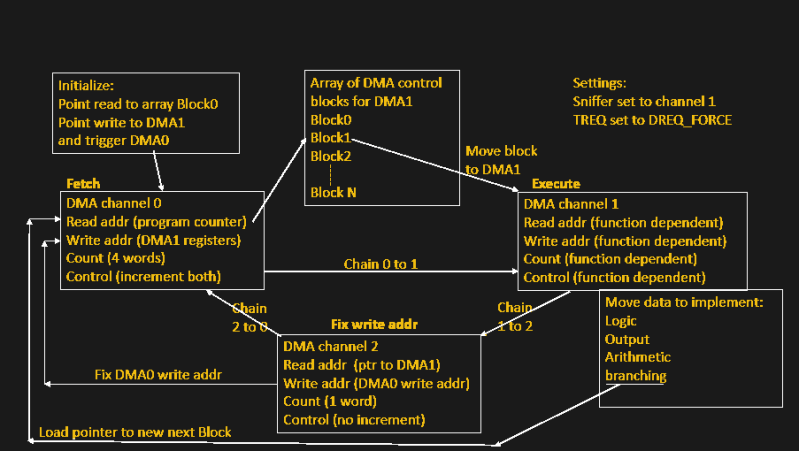
The method ties up three of the twelve DMA channels, and is estimated to have a similar performance to ‘an Arduino’ but [Bruce] doesn’t specify which one of the varied models that could be. But who cares anyway? Programming the CPU is a matter of leveraging the behaviour of the hardware, which is all memory mapped and targetable by the DMA. For example, the CPU can waggle GPIO pins by using the DMA to write values to the peripheral address space. The basic flow can be seen in the image above. DMA0 is used as the program counter, which points DMA1 to an array of DMA control blocks, a sequence of which codes for some of the ‘opcodes’ of the CPU model. DMA0 chains to (hands over control to) DMA1 which reads the control blocks and configures itself accordingly. DMA1 performs whatever data move is programmed, chains to DMA2, which in turn reprograms the DMA0 program counter to point to the next block in the list to be executed by DMA1.

By also using DMA1 to modify subsequent DMA1 control blocks (that’s self-modifying code happening there!) the system can implement more useful operations such as addition, logical operations, and conditional branching. Transport-triggered operations in certain shadow registers enable atomic set, reset, and XOR operations. All clever stuff, and a wonderful student project to have been involved with. [Bruce] points out a paper (using the Pi2) from the WOOT 2015 workshop which might offer a better explanation of this whole process.

If you’re still wondering who [Bruce Land] is and want a bit of a primer on some of these topics, then check out our previous coverage. If this theoretical stuff is a bit heavy (i.e. boring) then some of the projects have a more practical bent, such as the critical task of colour-sorting skittles.

Thumbnail image: Thomas Glau, CC BY-SA 4.0.

Hack a Day 21 Jan 03:00

80 percent of Twitter's full-time staff has evaporated under Musk

Elon Musk wasn't lying last October when he told Bloomberg that 75 percent of the employees at his newly acquired toy, Twitter.com, wouldn't lose their jobs under his ownership, as The Washington Post had reported at the time. Turns out, it's closer to 80 percent. Of the roughly 7,500 people working there before Musk's takeover, CNBC reports Friday that barely 1,300 in total, and fewer than 550 full-time engineers, are left at the husk of a company, either through said layoffs or voluntary resignations.

CNBC also notes that 75 employees are currently on leave, 40 of which are engineers, while the Trust and Safety team, which oversees content moderation for the site, has been culled to fewer than 20 full-timers. This news comes at the end of a seemingly ceaseless string of blunders since Musk announced an unsolicited $44 billion bid to buy the social media site last April

Aside from firing everyone that wasn't nailed down, Musk has reinstated numerous far-right and fascist accounts that had previously been permanently banned without so much as a second glance at the "moderation council" he was supposedly going to establish. He's made critical operational decisions based on Twitter polls — and that's after trying weasel out of the deal to purchase Twitter in the first place on trumped up complaints regarding the prevalence of bot users and how easy it is to game Twitter polls. 

He's used the banhammer to silence critics ranging from journalists to college kids. Musk has brought in employees from his other, unrelated companies, including members of the SpaceX and Tesla teams; and fired employees for questioning his business acumen. His $8 blue check verification scheme has haltingly rolled out in fits and starts, this while ad revenue is reportedly down 40 percent as advertisers look to escape his sinking ship. His first interest payment on the $13 billion debt he leveraged to purchase Twitter, which is today valued at around $15 billion, is due at the end of the month.

But Twitter isn't the only company shedding staff like water off a wet dog's coat. Google laid off 12,000 employees this week, Amazon disemployeed 18,000 people globally, and Microsoft eliminated 10,000 positions. Between the three, they've put about 70,000 people out of work in the last year alone.