Forspoken review: A magical world with several cracks

In Forspoken, you control the agile, angry Frey (voiced by Ella Balinska), slinging elemental attacks (and f-bombs) at multiple monsters before leaping off a cliff face and swinging from a molten outcrop. You keep moving, through the lands of Athia, through the adventure, because it’s really fun and satisfying, but also because when you slow down, you start to see the cracks.

Running on Square Enix’s in-house Luminous Engine (the team that made the game is a newly-formed group called Luminous Productions), Forspoken gives some beautiful moments of magical pyrotechnics, but it’s not quite up to the consistent environmental beauty (and attention to detail) of games like Horizon Forbidden West or Returnal. Still, most of the elemental effects, Frey’s movements and a lot of the world of Athia is beautifully realized.

The matriarchs that control the world, the Tantas, are fearsome, with a fascinating array of spells, lots of intrigue and a great wardrobe. Fighting, talking to and learning about the four leaders and their fall from grace are some of the highlights of Forspoken. Luminous Productions even said that the Tantas were a “labor of love” for the team, and that’s apparent.

Take Tanta Prav, the water-wielding Tanta of judgment (they all have a handy job title to explain how they’ll probably rough you up): She is delightfully unhinged and argues with herself. Surrounded by her own watery creations, she’s judge, jury and executioner – except there’s no-one left to judge. Until Frey kills one of her fellow Tantas.

Square Enix

Pretty soon after, she’s raving in Frey’s face and you immediately understand that you will have to stop her. The broader story has peaks and troughs, but most of the great moments and set-pieces across the middle-end of the game involve the Tantas’ machinations. Try sneaking (or just rushing) into the castle of the Tanta of Strength, with ballistas firing gobs of fire at you and minions surrounding you even as you dodge the hellfire. Later on, another Tanta pulls you ‘back’ into New York, and the environment playfully teases that all is not what it seems.

Square Enix

While most of the elemental effects, Frey’s movements and a lot of the desolate world of Athia is beautifully realized, other parts aren’t. The only populated region of the game, Cipal, is so underwhelming, relative to the antagonists and their fortresses. Take Auden, Frey’s first friend in Cipal, a city that’s the final bastion of humanity in Athia. She often interacts with Frey in the first and final few chapters of Forspoken – arguably she has more screen time than all but one of the Tantas. She’s also one of the main sources of information about Athia, why the Tantas are now unhinged despots and well, just how bleak everything is. End of the world aside, why does she look such a mess? Similarly, Tanta Cinta, who’s pivotal to the plot, seemed to be modeled by whoever did the dirty to poor Auden.

Minor characters are even rougher around the edges. This isn’t just a graphical problem either. It’s obvious where less effort’s been made. Open-world games with low-quality side quests (or game filler) are a regular occurrence – I’ve given up in the middle of Assassin’s Creed: Valhalla – but the majority of tasks in Forspoken are just too dull and unrewarding. I’m still chipping away at the game so if there are some pleasant surprises I will update this. But so far, it’s not looking good.

Following the primary story beats, while the magical parkour skills make dashing across land an effortless, speedy affair – and definitely faster than horses – there’s not a lot of impetus to explore too much. One of the major landmarks are giant bird cages indicating locked labyrinths. But so far as I’ve explored, they are simplistic junctions of monsters and corridors, with a sub-boss beastie at the end. Other sidequests – lots of them – are just like the fetch quests of Assassin’s Creed, Horizon, Ghost of Tsushima, Spider-Man and well, so many open-world games of the last 10 years.

Do you enjoy chasing things for collectibles? Welcome to the cat-chasing sidequests. How about doing it without your speedy magical parkour skills? Because that’s the reality– even when Frey is eventually accepted into the city, you’ll never get to dash across the city of Cipal, and leap up its walls. That means after you’ve traded with collectors, you will have to sprint like a normal human to the tavern. (Weirdly, the sprint button and the magical parkour button are not the same buttons, either.) The good thing is there’s not much to keep you in this town. Even if it’s the only populated area in the game, it’s the least interesting. Take the tavern: During celebrations, you will get to experience the most inconsequential, pointless, real-time event dance-off. The button presses and timings have little or nothing to do with the jigs and the moves Thankfully, it seemed to be a one-off.

Forspoken may offer an open world, but you won’t be able to confront the Tantas outside of the order the plot demands. Don’t worry, the sassy bangle Cuff is around to offer a bit of banter between story beats. It’s a weird relationship between Cuff and Frey: They both seem to dislike each other, but not in an endearing way. Frey may be able to traverse, well, pretty much everything with amazing ease, but despite Square Enix pulling in TV writing talent for Forspoken, there isn’t much depth or even much of a character arc to enjoy. Many major plot points are shoehorned in the final third of the game, and Frey’s sudden mood shifts never seem all that believable.

Outside of the main campaign, Forspoken offers plenty of opportunities for exploration, but the rewards don’t feel worth the time. When I unlocked a new cloak or accessory, they’d typically be specced way below my current equipment. I’d have to go for another magical 5K run to collect herbs and other materials to upgrade things to a decent level.

The sheer breadth of magical attacks meant I eventually fell into a pattern of using my favorites – until I picked up yet another tree of spells from another fallen Tanta. (It’s a shame you don’t get access to the final set of spells until just before the closing chapters of the game.)

The battles, when the skills come together and the camera and lock-on mechanism is consistent, are a delight. You shift between support spells, summoning two lava soldiers while raining down water attacks, throwing a reality-shifting charm over a few other enemies so they start tearing each other apart. You line up multiple enemies and cast your super-spell, sending a carpet of poisoned earth spikes across the battlefield.

Coming across a particularly difficult foe, usually glowing enemies classified as mutants, often meant waiting to unlock a family of elemental attacks that were more effective. Or, simply, a matter of mopping them up on your way back from another part of the map, stronger. The rewards for beating these often never seemed worth the effort of a challenging battle (or remembering to circle back to that location).

At other times, an invisible enemy would slam into me from behind the camera. The worst fight was during one of the later boss battles with an electric bird beast. It will circle above a city, seemingly forever. Steering Frey, I struggled to land even the most straightforward long-distance attacks. I even made myself dizzy. As the camera continued to swing around and around and around. What should have been a slick showcase for Frey’s agility and parkour talents turned into a war of attrition with bonus motion sickness.

My quests and exploration would regularly be interrupted by breakstorms, sending a barrage of monsters at you – monsters that wouldn’t drop loot, sadly. At other times, breakstorms would end if you killed the monsters in specific areas – or if you bested the super bosses that breakstorms would often spawn. Still working on that challenge, myself.

A lot of the story lore and worldbuilding is rooted in text snippets you’ll pick up in dungeons or rest spots – I wish more was communicated through the characters. Without spoiling things, there are other ‘twists’ that come across as cheap shortcuts, escaping the need for another lavish boss battle.

The core story will take between 30 and 40 hours, with some diversions. You can explore a handful of new areas post-game, but nothing so far is particularly captivating. I’m avoiding spoilers again, but a wrinkle at the very end of the post-game leads to a very lazy solution for the conclusions of the story, to ensure Frey can still live her best magical life after the credits roll.

Forspoken, running on a PS5, is smooth enough, but it will still buckle under a wave of enemies and enough magical pyrotechnics. Cranking up the graphical fidelity with either ray tracing or 4K makes for a very choppy kind of a game, especially during frenetic battles.

Like me before the final chapter, Forspoken doesn’t feel quite ready. Originally meant to launch in May 2022, this game’s already been pushed back a good nine months. Could it have done with a little longer? The main story is intriguing but too short, and the open-world distractions aren’t distracting enough. At one point, opening a pretty simplistic puzzle treasure chest – there are lots of them – Frey exclaims “Boring!”. Same, Frey, same.

Fortunately, the battle system is solid and fun, offering enough for gamers looking for an adventure, and hard mode is suitably hard enough to stretch anyone looking for a proper challenge. Frey references Alice in Wonderland several times, but after 30 hours the wonder had unfortunately dried up. If you enjoy the combat, however, and there’s a demo to try out, you might forgive the dullness, and be willing to see how deep the rabbit hole goes.
LG's latest CineBeam ultra short-throw projector is a dream — if you can afford it

Who wouldn't want a small box that can spit a 120-inch image onto your wall? That's the basic pitch behind 4K ultra short-throw (UST) projectors, which are sometimes called "Laser TVs." They're technically easier to set up than traditional projectors, and unlike large TVs, they don't require a huge footprint. Once you've placed it in front of a screen (or treated wall), you can summon an enormous cinematic image in an instant.

We've reviewed a few UST projectors over the years, most recently Formovie's excellent $3,000 model. Personally, I've been in love with LG's Cinebeam HU85L since we first saw it in action in 2019. Sure, it was expensive at over $6,000, but that was far less than the $10,000 earlier models cost (and certainly better than Sony's early eye-watering $30,000 to $40,000 UST projectors). Much like LG's first OLED TVs, the CineBeam represented everything I wanted from the future of home cinema.

Now after spending a few months with the company's latest UST, the CineBeam HU915QE, I'm even more enamored. It's brighter than its predecessor, reaching up to 3,700 lumens with a 2,00,000:1 contrast ratio, which makes it ideal for daytime viewing and HDR content. (Unfortunately, it doesn't support Dolby Vision, a rare feature we were surprised to see on the Formovie UST.) The new CineBeam can also be pushed even closer to your wall with the ability to spit out a 90-inch 4K image from 2.2-inches away, or a 120-inch image from 7.2-inches. I just wish it was cheaper than $5,000 — with the Formovie unit coming in at thousands less, it's hard to justify LG's premium.

The HU915QE looks similar to most other UST projectors — it's just a large rectangular box — and its design is practically the same as the previous CineBeam. Still, LG gave it enough flair to make it look at home in a classy living room. Its front speaker is covered in cloth, and the entire unit is encased in a solid light gray plastic. (There's also a black model for better nighttime viewing, though that one inexplicably spits out a darker image.) Around back, there are three HDMI ports, 2 USB connections, an optical audio port and Ethernet. It's not exactly heavy, at 26.9 pounds, but you definitely need a wide table or credenza to align it with your screen.

Devindra Hardawar/Engadget

That setup process, by the way, is more annoying than you'd think. Configuring any projector is a pain, as you'll need to place it in just the right spot to fill your screen. With a traditional long- or short-throw projector, you're often able to shift the lens around manually. But configuring a UST like the CineBeam involves finding the exact height and distance from the screen to make everything look perfect. If it gets nudged by even a millimeter, the image will simply look wrong. That makes USTs less than ideal for homes with small children or overzealous pets. (Also, you don't want kids peeking into the projector lens, as it's bright enough to cause serious eye damage. That’s hard to do with a traditional projector, but far too easy when it’s just sitting on the floor)

When I tested the previous CineBeam HU85L, it took me a few hours to find the proper position to work alongside my dropdown projector screen. That involved buying a small table and stacking a few wide boxes to get everything aligned. Even then, I couldn't quite get the image to fill every corner of my screen properly. That's when I learned that dropdown screens aren't ideal for UST projectors (Engadget's Steve Dent also found that small creases in dropdown screens could lead to rippled images). Ultimately, I was able to get the older CineBeam to fill around 98 percent of my 120-inch screen, but I gave up on the dream of having the whole thing covered.

Thankfully, I was able to drop the HU915QE into the exact same spot as the earlier CineBeam. After tweaking the manual focus wheel a bit, it ended up covering the same area of my screen. If you're building your home theater or living room around a UST projector, you'll ideally want to use a tensioned ALR (ambient light rejection) screen. Those are built to block light from everywhere but your projector, which means they'll deliver even better brightness and contrast. If you want to use a UST during the day like a TV, you'll definitely want to push away as much ambient light as possible.

While my setup wasn't ideal, the CineBeam HU915QE still delivered most of what I wanted: A large and luscious dose of cinema in my basement screening room. Almost immediately, I noticed that it produced richer and more vibrant colors than the CineBeam HU85L. Colorful films like Thor Ragnarok looked just fine on the previous projector, but the new model delivered a far bolder dose of cosmic psychedelia. The improved contrast also made the HU915QE better suited for dark scenes, like the spooky nighttime sequences in Nope where you’re trying to make out something floating through the clouds.

The HU915QE is a triple laser projector, relying on red and blue lasers for their respective primary colors, as well as another blue laser shining through a phosphor to create green. That setup works well, but it can only reach 94 percent of the DCI-P3 color gamut. Newer UST projectors with three distinct RGB lasers, like the HiSense PX1-Pro, can reach a wider 107 percent of the BT.2020 gamut. Like many other UST units, the HU915QE relies on pixel shifting to achieve a visible 4K resolution. It has a native resolution of 2,716 x 1,528, which is shifted twice to hit 4K. The result is an image that's sharper than cheaper projectors, which typically have 1080p native resolutions with four-phase shifting.

After spending a few hundred hours watching everything from streaming shows like Midnight Mass, to blockbuster action films like Top Gun: Maverick, I found myself preferring the experience of using the HU915QE compared to trekking out to the theater for many films. And, to be clear, that’s a pretty big deal for a movie lover like me. Even with the COVID-19 pandemic threatening the viability of theaters, I’ve held out hope for a comeback. The strong box office performance of the Top Gun sequel and Avatar: The Way of Water makes me think that there’s still room for the true cinematic experience (though as I write this, Regal is shuttering more locations in the US after its parent company Cineworld declared bankruptcy last September). Those films, as well as the recent Dune adaptation, are so large and bombastic that even a 120-inch home projector can’t fully capture their grandeur. But the HU915QE sure comes close.

Devindra Hardawar/Engadget

Like most projectors, the CineBeam HU915QE isn’t ideal for gaming thanks to its noticeable input lag. Still, I had a great time playing PS5 titles like God of War Ragnarok, Ratchet and Clank: Rift Apart and even the fast-paced Returnal on my giant screen. LG hasn’t issued any latency figures, but some reviews peg the projector’s input lag between 50ms and 67ms. There’s an auto low-latency mode that cuts off extra processing to speed things up, but you obviously won’t be using this thing for lightning-fast competitive gaming. Based on my experience with the 55-inch Samsung Odyssey Ark, though, that’s not something you’d want to do on a gigantic display anyway. Twitch gaming requires smaller screens so you can actually focus on all of the super-fast action.

When it comes to sound, I can’t imagine that anyone buying a $5,000 projector would be relying on built-in speakers, but it may make sense if you just want to avoid extra clutter in your living room. The CineBeam’s 40-watt 2.2 speaker setup sounds good enough for casual viewing – it’s certainly far better than what you’d get on modern TVs. It’s basically a fairly simple soundbar sitting below the projector, but it delivers clear dialogue and some surprisingly boomy bass. Seriously though, look into surround sound systems if you’re actually buying this thing. You deserve it.

Devindra Hardawar/Engadget

While I spent most of my time using an Apple TV 4K, the HU915QE is also powered by LG’s WebOS platform, which offers all of the smart TV apps you’d expect. That’s nice to have, especially if you don’t want to juggle multiple remotes, but I’d wager most home theater fans will stick with their set-top box platform of choice. If you’re used to WebOS from LG’s OLED TVs, you’ll feel right at home with this projector. It even uses the same Magic Remote found on LG’s TVs, which has voice controls and (so-so) motion controls.

As much as I loved the CineBeam HU915QE, it’s not exactly priced competitively against newer entries like the $3,000 Formovie Theater. Sure, that’s not as bright, but at half the price of the CineBeam, that projector delivers Dolby Vision, great sound and excellent image quality thanks to a modern triple-laser setup. You can easily add in an excellent $2,000 surround sound system to match the CineBeam's price . As for other high-end competitors, the HU915QE competes directly with Hisense’s much-lauded L9G, which currently sells for $4,500 to $5,000 depending on the screen you get. Samsung’s Premiere LSP9T triple-laser UST also retailed for $6,500 when it debuted, though it can now be found for around $3,500 at online sellers.

If you’re an LG loyalist, the CineBeam HU915QE is still a very compelling UST projector. It offers enough brightness to use during the day, and it’s vibrant enough in darker rooms to deliver a truly cinematic experience. But it’ll be an even better buy once it comes down in price.

The Morning After: Microsoft expands 'multibillion dollar' deal with OpenAI, creators of ChatGPT

Microsoft is making a "multibillion-dollar" investment that will lead to wider uses of OpenAI's technology, as well as more robust behind-the-scenes support. Microsoft has launched OpenAI-powered features, like natural language programming and a DALL-E 2 graphic design tool. OpenAI uses Microsoft's infrastructure to train its best-known systems, including DALL-E 2 and the popular ChatGPT bot. ChatGPT is coming to Azure soon. However, don't expect anyone to see ChatGPT in Bing – at least not yet. The expansion may help Microsoft seize a competitive advantage. Google reportedly sees ChatGPT as a threat to its search business,

The versatile AI chatbot is having a surge in popularity. The existing version already had more than one million users around December 2022. That's probably grown, too – and Microsoft wouldn't mind a piece of that.

– Mat Smith

The biggest stories you might have missed

MacBook Pro 14-inch review (2023)

With M2 Pro or M2 Max power, a blessing for creatives.

Engadget

With its last batch of MacBook Pros, Apple gave its more demanding fans everything they wanted: tons of ports, lots of power and genuinely great screens. This time, it's just a straightforward chip upgrade, featuring the new M2 Pro and M2 Max. They're faster, as you'd expect, and they deliver a few features power users may appreciate, like 8K video output and support for WiFi 6E. The new MacBook Pro 14-inch isn't a dramatic departure from the last model, but the new chips will be incredibly useful to creative professionals.

Continue reading.


Elon Musk says his SpaceX shares would've funded his plan to take Tesla private

He took the witness stand again to defend his 'funding secured' tweets.

Elon Musk said he could've sold his SpaceX shares to take Tesla private when he took the witness stand again to defend his 2018 "funding secured" tweets in a lawsuit filed by the automaker's shareholders. According to CNBC, Musk proclaimed: "SpaceX stock alone meant 'funding secured' by itself. It's not that I want to sell SpaceX stock but I could have, and if you look at the Twitter transaction – that is what I did. I sold Tesla stock to complete the Twitter transaction. And I would have done the same here."

The plaintiffs' lawsuit is based on Musk's infamous 2018 tweets in which he said he was "considering taking Tesla private at $420." The judge in this case has already determined his tweets were "objectively false and reckless." However, the plaintiffs still have to prove Musk knew his tweets were misleading and caused their losses to win the case. Musk and Tesla previously had to pay the Securities and Exchange Commission $20 million each to settle a separate lawsuit over the same tweets, accusing him of making "false and misleading statements" that could constitute fraud.

Continue reading.

Microsoft to stop selling Windows 10 downloads

Sales will be cut off on January 31st.

Microsoft is stopping sales of Windows 10 downloads on January 31st, according to a product page spotted by The Verge. That date "will be the last day this Windows 10 download [and all-important license keys] are offered for sale," according to Microsoft. However, it will continue to support Windows 10 with security updates until it's discontinued for good in October 2025. Windows 10 launched in 2015 and will be discontinued exactly 10 years later. The company announced its end date in June 2021 as part of its "modern lifecycle policy," just before the launch of Windows 11.

Continue reading.

Apple's mixed reality headset could feature full-body FaceTime avatars

We might see it this spring.

We're expecting Apple to reveal a mixed reality headset in the coming months. It'll be Apple's first new product category since Apple Watch, which debuted in 2015. Bloomberg's Mark Gurman has shared details about what to expect from the product, which may be called Reality Pro. The standalone device will have an interface similar to an iPhone and iPad and the option to pin widgets to the home screen. Alternatively, it may be used as an external display for a connected Mac. Along with Siri voice commands, there'll be the option to use a Mac, iPhone or iPad keyboard to enter text on the xrOS operating system, according to the report.

For one-on-one chats in which both participants wear a Reality Pro, the report also suggests FaceTime will render realistic versions of their face and body. Yes, that means legs! The device is rumored to appear ahead of Apple's Worldwide Developers Conference in June, with a release to follow in fall. The price, though, may put many off. The headset could retail for around $3,000. That's twice as much as the Meta Quest Pro.

Continue reading.

Garmin debuts an ECG app, but it's only available on one smartwatch

Garmin hasn't yet had a dedicated electrocardiogram (ECG) app despite the health focus of its wearables, but it's filling that gap today. The company has introduced a simply-titled ECG App that, like equivalents on other devices, can study your heart rhythm and look for atrial fibrillation (aka AFib). If there are signs of trouble, you can sync your results with Garmin Connect and create a report you can share with healthcare providers.

You will have to be fussy about your choice of devices to use this software right away. Garmin is currently offering the app only to Venu 2 Plus owners in the US. They'll need to update both their firmware and the Connect app. The company plans to add support for more devices and countries over time, but that will require further government approvals. Don't expect your running watch to get an ECG app for a while.

This is the first app Garmin has cleared with the US Food and Drug Administration. As with similar apps, it's not meant to be a definitive verdict on your heart health and won't detect cardiac arrest. Your watch only offers functionality comparable to a single-lead ECG — your doctor can use a multi-lead system that will present a more accurate picture of your condition. Garmin VP Dan Bartel notes that this app is mainly helpful for spotting AFib in the early stages, when it's "difficult to detect" at a clinic.

There are plenty of alternatives if ECG is a must-have feature. Apple, Google (including Fitbit), Samsung, Withings and others have had the technology in their watches for a while. It's difficult to complain about having more choices, though, and this may be appealing if you prefer Garmin's overall fitness and health tracking capabilities.

The 2024 Polestar 2 will have better range, stronger motors and a SmartZone sensor suite

If you just bought a 2023 Polestar 2, hoooo boy are you about to be mad. The company on Tuesday showed off some of the, ahem, numerous updates that the upcoming 2024 model year PS2 will sport, including next-generation motors, a slew of new standard equipment, a more potent battery pack and the SmartZone sensor suite first teased on the Polestar 3. Also, the previously front-wheel drive single motor Polestar 2 — that's RWD now, so let the drifting begin!

The Polestar 2 is now a fully RWD platform for the single-motor variant that arrived in March. It uses newly devised permanent magnet motor and silicon carbide inverter technologies to increase the horsepower output from 231 to 299 hp. Torque similarly jumps from 243 lb-ft to 361, putting it in line with the Tesla Model 3's output, while the 0-60 figure drops more than a full second compared to the old motor, to 5.9 seconds. 

Polestar

The dual-motor AWD version will see equivalent performance gains — 421 hp and 546 lb-ft, up from 408 hp and 467 lb-ft — as well as improved traction and a 0-60 of 4.3 seconds. Opt for the 2024 Performance pack and the horsepower jumps to 455 and the 0-60 drops to 4.1 seconds. The powertrain and torque ratios in the dual-motor version have been given a rear-wheel bias and, when the extra performance of AWD isn't necessary, the second (front) motor can be disengaged to improve efficiency and range (using the larger battery of 82 kWh) up to 300 miles, a 10 percent increase. 

The PS2's battery is receiving some slight chemistry tweaks as well. It to now offer a max 205kW charge rate while requiring 1.1 fewer tons of carbon emissions to produce — now just 5.9 tons per battery pack! Note however that this specifically applies to the Long Range single motor variant, the dual-motors both are stuck with the existing 78 kWh packs charging at 155 kW. 

Polestar

“Changing from front- to rear-wheel drive in the single-motor variants, and re-calibrating the torque ratio in the dual-motor variant for an increased rear-wheel drive feel, elevates the Polestar 2 driving experience to a whole new level,” Joakim Rydholm, Head of Chassis Development, said in a press release. “The updated Polestar 2 is an even more playful and agile car, retaining its compactness and complete sense of control, while at the same time becoming more mature with added comfort.”

Polestar

Next year's PS2 will be quite a bit smarter than its predecessor thanks to tech first shown off by its successor, the PS3. Polestar's SmartZone, mounted in the vehicle's vestigial front grille, houses an improved mid-range radar array and front-facing camera. A number of ADAS systems will come standard as well. For example, the Pilot Pack (which includes the 360-degree camera, parking assist and adaptive cruise control) will now come standard on the long-range dual motor PS2, while every trim level will get wireless device charging. And for folks that purchase the Performance package (Brembo brakes, 20-inch rims and a performance software upgrade) will receive the Plus package (Harmon Kardon stereo, panoramic glass roof, air quality software that sounds like something everyone should get just like the device charging) for no additional cost. Deliveries are expected to begin later this year and Polestar's online order window has already opened. 

WhatsApp's native Mac app beta is now available to all

Mac users who have been waiting for a native version of WhatsApp can now download it without restrictions, WaBetaInfo has reported. The new app is optimized for Mac hardware and built with Mac Catalyst, so it should be faster and more efficient than the current web-wrapped Electron version. You also get a new interface with three panels to easily flip between chats, calls, archived and starred messages, while seeing contacts and interactions at a glance.  

Apple's Catalyst was designed to allow developers to port iOS apps over to macOS or create just one version that can run on either platform. Since the Mac was developed on Catalyst, that lends some hope that a long-awaited version may also come to iOS. In 2021, Meta said that it was expanding multi-device support for WhatsApp, leading to speculation that an iPad app was forthcoming.

Last year, WhatsApp released a native version for Windows 10 that works without the need for a smartphone. It looks much the same as the Mac app and also offers increased reliability and speed.

The native macOS app has been around for several months on TestFlight, but that only offers limited slots for testers. Now that it's in a full beta, though, you can download it directly from WhatsApp's website

Amazon's RxPass offers Prime members generic medications for $5 a month

Amazon has launched a new subscription service that will let customers in the US get as many eligible medications as they need for $5 a month. The new service called RxPass is part of the e-commerce giant's Pharmacy business that originally launched in 2020 as a two-day prescription drug delivery offering for Prime users. That makes RxPass a $5 add-on for Prime, which sets users back $139 a year or $15 a month in the US. 

While it doesn't look quite as affordable bundled with Prime pricing, the RxPass program does offer medications for 80 common health conditions, including high blood pressure, acid reflux, anemia and even depression, diabetes, breast cancer and dementia. At the moment, it has 60 generic medications in its list — all of which require a valid prescription — and subscribers can choose to have them delivered for free either on a monthly or a quarterly basis. 

Take note that customers will need to pay $5 out of pocket, since the service does not take insurance like Amazon Pharmacy does for purchases outside of the program. People who are enrolled to Medicare, Medicaid and any other government healthcare program will not be able to sign up for RxPass, as well, though they can still use their government insurance when purchasing medicine from Pharmacy.

For people with multiple conditions paying a lot more than $5 a month for their medications out of pocket, RxPass could be worth trying out, especially if they already have Prime. Those interested may want to take a look at the service's full medication list first to see if it does offer what they need before heading to the Pharmacy website or the Amazon app to sign up. 

ASML Technologies; The Backbone of Taiwan and China’s Semiconductor Growth

ASML Technologies; The Backbone of Taiwan and China’s Semiconductor Growth

The US wants to inflict sanctions on ASML so that it cannot do business deals with China

Staff Tue, 01/24/2023 - 15:40
Circuit Digest 24 Jan 10:10

Lightyear suspends production of its first solar EV to concentrate on its second

After shipping its first solar EV only weeks ago, Dutch automaker Lightyear has announced that it's suspending production of that model (called the 0) to focus on the more affordable Lightyear 2. It made the move after opening a waitlist for the Lightyear 2 that generated more than 40,000 subscriptions on top of the existing 20,000 pre-orders from fleet owners. 

"In order to safeguard our vision, we had to decide to redirect our focus and resources completely towards Lightyear 2," the company wrote in a press release. "This means in effect that we had to suspend the production of Lightyear 0." The company didn't provide a timeline for Lightyear 2 production or other details.

The news does raise concerns about the company's financial situation. Lightyear said it submitted a request "to open suspension of payment proceedings" in relation to its operating company responsible for producing the Lightyear 0. (Companies in The Netherlands can request to have debts frozen for 18 months to buy time to reorganize, according to TechCrunch.) The company said it hopes to "conclude some key investments in the coming weeks in order to scale up to the Lightyear 2."

The Lightyear 0 costs nearly $300,000 and was designed to produced in limited quantities, much like the Polestar 1. On the other hand, the Lightyear 2 will cost around $40,000, according to the company. It's supposed to have up to 500 miles of range, aided by its solar panels, but the company has yet to reveal other details or show complete images of the vehicle.

The concept of both EVs is the same. The car’s solar panels can provide up to 44 miles of range on a sunny day, meaning drivers with relatively short commutes may rarely need to charge their vehicles. For longer distances, the vehicles have battery packs that provide nearly 400 miles of extra range, in the case of the Lightyear 0. That's also aided by very slippery aerodynamic profiles. 

Arduino is out to (Rocket) Launch

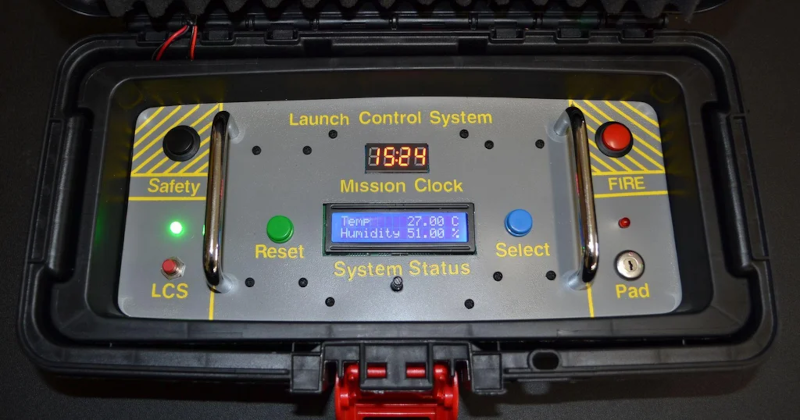
It looks like an ordinary toolbox, but when you open up the Arduino Launch Control System, you’ll find a safe method for triggering model rocket launches. The system uses two separate power supplies. Both must be on for a successful launch and one requires a key. To trigger a 10-second countdown, the operator must hold down two buttons. Releasing either button will stop the countdown.

Besides safety, the controller tracks mission elapsed time and can read weather information from a few sensors. A good-looking build and we like the idea of building inside a toolbox for this sort of thing.

Towards the end of the post, there are some ideas for improving the build, like using a consolidated weather sensor, using a larger screen, and a bigger, more capable controller. It seems like more I/O would be useful,

Model rocketry isn’t as rigorous as launching a crew, but there were a few things that could improve the overall system safety. For example, the launch buttons could provide both normally open and normally closed contacts to guard against switch failure. In other words, if you see both inputs from one switch on or off for more than a tiny moment during switching, you can assume the switch has failed and put the system in a fail-safe mode. Of course, a switch failure in the off position isn’t a hazard, just an inconvenience. But a switch failure in the active position could allow an inadvertent launch. Granted, it would require something jamming the remaining switch for the entire 10-second countdown, but still. Arduinos are pretty reliable, but for a real rocket system, you’d probably have redundancy, and the software would do periodic checks to guard against things like memory corruption.  For example, NASA has a relatively succinct list of requirements. But some of this is overkill for a model rocket launcher.

We’ve seen many takes on this kind of project. Of course, like everything else these days, you can just use your smartphone.